


Page 409 - The City and Guilds Textbook: Plumbing Book 1 for the Level 3 Apprenticeship (9189), Level 2 Technical Certificate (8202) and Level 2 Diploma (6035)
P. 409
Chapter 6 Hot water systems

                The bladder (bag) type expansion vessel
                Also known as the bag-type expansion vessel, this is usually made from steel
                and contains a neoprene rubber bladder to accept the expanded water. At no
                time does the water come into contact with the steel vessel as it is contained at
                all times within the bladder.
                The inside of the steel vessel is filled with either air or nitrogen to a predetermined
                pressure. The initial pressure charge from the manufacturer is usually made with
                nitrogen to negate the corrosive effects on the steel vessel’s interior. A Schrader valve is
                fitted to allow the pressures to be checked and to allow an air ‘top-up’ if this becomes
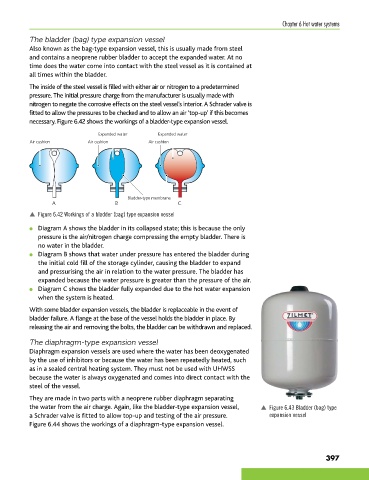
                necessary. Figure 6.42 shows the workings of a bladder-type expansion vessel.

                                      Expanded water      Expanded water
                Air cushion        Air cushion        Air cushion


                                                Bladder-type membrane
                       A                    B                   C
                p  Figure 6.42 Workings of a bladder (bag) type expansion vessel

                ●  Diagram A shows the bladder in its collapsed state; this is because the only
                   pressure is the air/nitrogen charge compressing the empty bladder. There is
                   no water in the bladder.
                ●  Diagram B shows that water under pressure has entered the bladder during
                   the initial cold fill of the storage cylinder, causing the bladder to expand
                   and pressurising the air in relation to the water pressure. The bladder has
                   expanded because the water pressure is greater than the pressure of the air.
                ●  Diagram C shows the bladder fully expanded due to the hot water expansion
                   when the system is heated.
                With some bladder expansion vessels, the bladder is replaceable in the event of
                bladder failure. A flange at the base of the vessel holds the bladder in place. By
                releasing the air and removing the bolts, the bladder can be withdrawn and replaced.

                The diaphragm-type expansion vessel
                Diaphragm expansion vessels are used where the water has been deoxygenated
                by the use of inhibitors or because the water has been repeatedly heated, such
                as in a sealed central heating system. They must not be used with UHWSS
                because the water is always oxygenated and comes into direct contact with the
                steel of the vessel.
                They are made in two parts with a neoprene rubber diaphragm separating
                the water from the air charge. Again, like the bladder-type expansion vessel,   p  Figure 6.43 Bladder (bag) type
                a Schrader valve is fitted to allow top-up and testing of the air pressure.   expansion vessel
                Figure 6.44 shows the workings of a diaphragm-type expansion vessel.


                                                                                                                397


        9781510416482.indb   397                                                                                    29/03/19   9:02 PM

