


Page 412 - The City and Guilds Textbook: Plumbing Book 1 for the Level 3 Apprenticeship (9189), Level 2 Technical Certificate (8202) and Level 2 Diploma (6035)
P. 412
The City & Guilds Textbook: Plumbing Book 1


                                             ACTIVITY
                                             Transposing the formula P V  = P V  as shown in the example on the previous
                                                                   1 1
                                                                         2 2
                                             page, find the initial cold fill pressure of the expansion vessel and the final hot
                                             operating pressure of the storage cylinder.
                                             Where:

                                                P  = Initial pressure = 1.5 bar
                                                 1
                                                V  = Initial volume = 18 litres
                                                 1
                                                P  = Final pressure = to be found
                                                 2
                                                V  = Final volume = 18 litres − 9 litres of expanded water
                                                 2
                                            Pressure relief valve
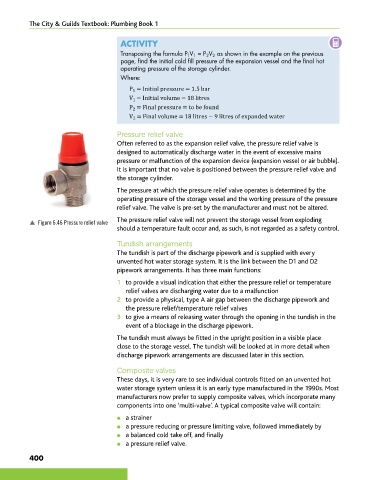
                                            Often referred to as the expansion relief valve, the pressure relief valve is
                                            designed to automatically discharge water in the event of excessive mains
                                            pressure or malfunction of the expansion device (expansion vessel or air bubble).
                                            It is important that no valve is positioned between the pressure relief valve and
                                            the storage cylinder.
                                            The pressure at which the pressure relief valve operates is determined by the
                                            operating pressure of the storage vessel and the working pressure of the pressure
                                            relief valve. The valve is pre-set by the manufacturer and must not be altered.


                p  Figure 6.46 Pressure relief valve  The pressure relief valve will not prevent the storage vessel from exploding
                                            should a temperature fault occur and, as such, is not regarded as a safety control.

                                            Tundish arrangements
                                            The tundish is part of the discharge pipework and is supplied with every
                                            unvented hot water storage system. It is the link between the D1 and D2
                                            pipework arrangements. It has three main functions:

                                            1  to provide a visual indication that either the pressure relief or temperature
                                               relief valves are discharging water due to a malfunction
                                            2  to provide a physical, type A air gap between the discharge pipework and
                                               the pressure relief/temperature relief valves
                                            3  to give a means of releasing water through the opening in the tundish in the
                                               event of a blockage in the discharge pipework.

                                            The tundish must always be fitted in the upright position in a visible place
                                            close to the storage vessel. The tundish will be looked at in more detail when
                                            discharge pipework arrangements are discussed later in this section.

                                            Composite valves
                                            These days, it is very rare to see individual controls fitted on an unvented hot
                                            water storage system unless it is an early type manufactured in the 1990s. Most
                                            manufacturers now prefer to supply composite valves, which incorporate many
                                            components into one ‘multi-valve’. A typical composite valve will contain:

                                            ●  a strainer
                                            ●  a pressure reducing or pressure limiting valve, followed immediately by
                                            l  a balanced cold take off, and finally
                                            ●  a pressure relief valve.

                400


        9781510416482.indb   400                                                                                    29/03/19   9:02 PM

