


Page 549 - The City and Guilds Textbook: Plumbing Book 1 for the Level 3 Apprenticeship (9189), Level 2 Technical Certificate (8202) and Level 2 Diploma (6035)
P. 549
Chapter 8 Rainwater systems

                For buildings without fascia boards
                There are two methods of fixing to dwellings without fascia boards. These are as
                follows.
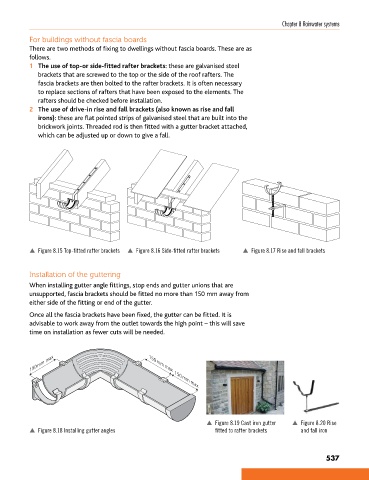
                1  The use of top-or side-fitted rafter brackets: these are galvanised steel
                   brackets that are screwed to the top or the side of the roof rafters. The
                   fascia brackets are then bolted to the rafter brackets. It is often necessary
                   to replace sections of rafters that have been exposed to the elements. The
                   rafters should be checked before installation.
                2  The use of drive-in rise and fall brackets (also known as rise and fall
                   irons): these are flat pointed strips of galvanised steel that are built into the
                   brickwork joints. Threaded rod is then fitted with a gutter bracket attached,
                   which can be adjusted up or down to give a fall.


                p  Figure 8.15 Top-fitted rafter brackets  p  Figure 8.16 Side-fitted rafter brackets  p  Figure 8.17 Rise and fall brackets


                Installation of the guttering
                When installing gutter angle fittings, stop ends and gutter unions that are
                unsupported, fascia brackets should be fitted no more than 150 mm away from
                either side of the fitting or end of the gutter.
                Once all the fascia brackets have been fixed, the gutter can be fitted. It is
                advisable to work away from the outlet towards the high point – this will save
                time on installation as fewer cuts will be needed.


                150mm max                              150mm max  150mm max


                                                                         p  Figure 8.19 Cast iron gutter   p  Figure 8.20 Rise
                p  Figure 8.18 Installing gutter angles                     fitted to rafter brackets   and fall iron


                                                                                                                537


        9781510416482.indb   537                                                                                    29/03/19   9:04 PM

