


Page 57 - The City and Guilds Textbook: Plumbing Book 1 for the Level 3 Apprenticeship (9189), Level 2 Technical Certificate (8202) and Level 2 Diploma (6035)
P. 57
Chapter 1 Health and safety practices and systems
The supply of electricity to a construction site
To maintain site safety, the supply of electricity to a construction site or
workshop should always be distributed by means of a reduced voltage system.
This system ensures that the correct voltage is supplied to where it is required:
● woodworking machines in a workshop require a 400 V 3 phase supply
● site office lighting requires a voltage of 230 V 1 phase supply
● site portable power tools and site lighting require a 110 V 1 phase supply.
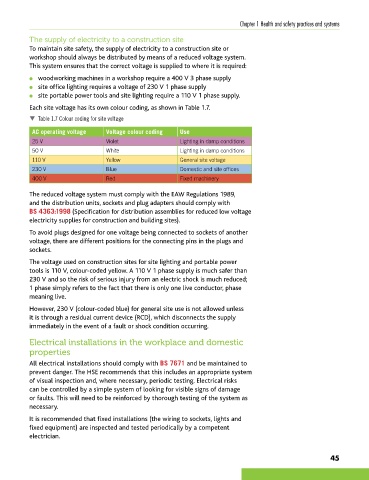
Each site voltage has its own colour coding, as shown in Table 1.7.
Table 1.7 Colour coding for site voltage
AC operating voltage Voltage colour coding Use
25 V Violet Lighting in damp conditions
50 V White Lighting in damp conditions
110 V Yellow General site voltage
230 V Blue Domestic and site offices
400 V Red Fixed machinery
The reduced voltage system must comply with the EAW Regulations 1989,
and the distribution units, sockets and plug adapters should comply with
BS 4363:1998 (Specification for distribution assemblies for reduced low voltage
electricity supplies for construction and building sites).
To avoid plugs designed for one voltage being connected to sockets of another
voltage, there are different positions for the connecting pins in the plugs and
sockets.
The voltage used on construction sites for site lighting and portable power
tools is 110 V, colour-coded yellow. A 110 V 1 phase supply is much safer than
230 V and so the risk of serious injury from an electric shock is much reduced;
1 phase simply refers to the fact that there is only one live conductor, phase
meaning live.
However, 230 V (colour-coded blue) for general site use is not allowed unless
it is through a residual current device (RCD), which disconnects the supply
immediately in the event of a fault or shock condition occurring.
Electrical installations in the workplace and domestic
properties
All electrical installations should comply with BS 7671 and be maintained to
prevent danger. The HSE recommends that this includes an appropriate system
of visual inspection and, where necessary, periodic testing. Electrical risks
can be controlled by a simple system of looking for visible signs of damage
or faults. This will need to be reinforced by thorough testing of the system as
necessary.
It is recommended that fixed installations (the wiring to sockets, lights and
fixed equipment) are inspected and tested periodically by a competent
electrician.
45
9781510416482.indb 45 29/03/19 8:50 PM

