


Page 59 - The City and Guilds Textbook: Plumbing Book 1 for the Level 3 Apprenticeship (9189), Level 2 Technical Certificate (8202) and Level 2 Diploma (6035)
P. 59
Chapter 1 Health and safety practices and systems

                it is necessary to have in place a programme of inspection and electrical safety
                testing of portable appliances.

                Records should be kept of all inspections and tests made and these should be
                up to date at all times. PAT testing helps to ensure:

                ●  earlier recognition of potentially serious equipment faults, such as poor
                   earthing
                ●  discovery of inappropriate electrical supply
                ●  discovery of incorrect fuses being used
                ●  the misuse of portable equipment can be monitored
                ●  an increased awareness of hazards linked to electricity.
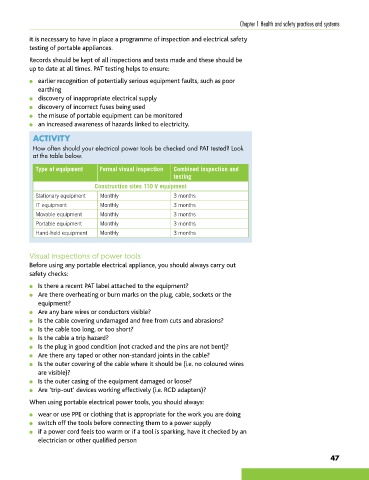
                 ACTIVITY
                 How often should your electrical power tools be checked and PAT tested? Look
                 at the table below.

                  Type of equipment    Formal visual inspection  Combined inspection and
                                                               testing
                                     Construction sites 110 V equipment
                  Stationary equipment  Monthly                3 months
                  IT equipment         Monthly                 3 months
                  Movable equipment    Monthly                 3 months
                  Portable equipment   Monthly                 3 months
                  Hand-held equipment  Monthly                 3 months


                Visual inspections of power tools
                Before using any portable electrical appliance, you should always carry out
                safety checks:
                ●  Is there a recent PAT label attached to the equipment?
                ●  Are there overheating or burn marks on the plug, cable, sockets or the
                   equipment?
                ●  Are any bare wires or conductors visible?
                ●  Is the cable covering undamaged and free from cuts and abrasions?
                ●  Is the cable too long, or too short?
                ●  Is the cable a trip hazard?
                ●  Is the plug in good condition (not cracked and the pins are not bent)?
                ●  Are there any taped or other non-standard joints in the cable?
                ●  Is the outer covering of the cable where it should be (i.e. no coloured wires
                   are visible)?
                ●  Is the outer casing of the equipment damaged or loose?
                ●  Are ‘trip-out’ devices working effectively (i.e. RCD adapters)?

                When using portable electrical power tools, you should always:
                ●  wear or use PPE or clothing that is appropriate for the work you are doing
                ●  switch off the tools before connecting them to a power supply
                ●  if a power cord feels too warm or if a tool is sparking, have it checked by an
                   electrician or other qualified person

                                                                                                                 47


        9781510416482.indb   47                                                                                     29/03/19   8:50 PM

