


Page 592 - The City and Guilds Textbook: Plumbing Book 1 for the Level 3 Apprenticeship (9189), Level 2 Technical Certificate (8202) and Level 2 Diploma (6035)
P. 592
The City & Guilds Textbook: Plumbing Book 1
Traps
INDUSTRY TIP
The purpose of a trap is to stop obnoxious smells from entering the dwelling.
Copper- and brass-made There are many different types of trap, to suit numerous appliances and
traps can be chrome plated applications. Traps are generally manufactured from polypropylene to BS 3943
for a luxury finish and are for domestic applications but can also be made from copper or brass. Jointing
usually used with chrome- methods include push-fit type joints and compression type with a rubber
plated copper waste pipe. compression ring.
Trap depths and sizes
To recap pipe sizes and trap depths, remember where a trap diameter is 50 mm
INDUSTRY TIP and above, the trap seal must be 50 mm, such as the traps in WC pans. There are
two reasons for this, both of which are reliant upon the cohesive quality of water:
Water has both cohesive and
adhesive qualities and these 1 A trap with a diameter of 50 mm and over contains more water than, say, a
were explored in Chapter 3, 32 mm or 40 mm diameter trap. This makes the water much more difficult
Scientific principles, page 161. to move by induced siphonage, wavering out or compression.
2 Because of the pipe size, it is unlikely that an appliance will discharge at full
bore. If a pipe runs at full bore it will try to pull air along with it. If there is no
air to pull, then the water in the trap is pulled instead until the trap is empty
and the pipe can pull air, thus breaking the siphonic action.
Where a waste pipe runs into a hopper head or a gulley, the trap depth can be
reduced to 50 mm for washbasins, kitchen sinks and electrical appliances such
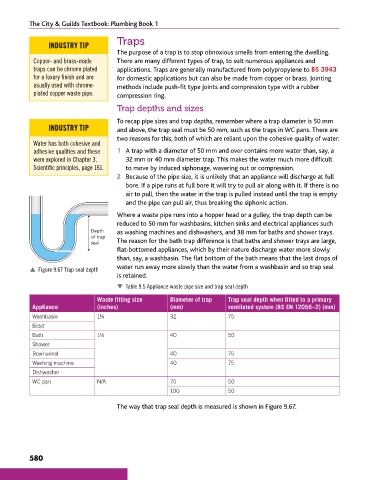
Depth as washing machines and dishwashers, and 38 mm for baths and shower trays.
of trap
seal The reason for the bath trap difference is that baths and shower trays are large,
flat-bottomed appliances, which by their nature discharge water more slowly
than, say, a washbasin. The flat bottom of the bath means that the last drops of
p Figure 9.67 Trap seal depth water run away more slowly than the water from a washbasin and so trap seal
is retained.
Table 9.5 Appliance waste pipe size and trap seal depth
Waste fitting size Diameter of trap Trap seal depth when fitted to a primary
Appliance (inches) (mm) ventilated system (BS EN 12056–2) (mm)
Washbasin 1¼ 32 75
Bidet
Bath 1½ 40 50
Shower
Bowl urinal 40 75
Washing machine 40 75
Dishwasher
WC pan N/A 75 50
100 50
The way that trap seal depth is measured is shown in Figure 9.67.
580
9781510416482.indb 580 29/03/19 9:07 PM

