


Page 657 - The City and Guilds Textbook: Plumbing Book 1 for the Level 3 Apprenticeship (9189), Level 2 Technical Certificate (8202) and Level 2 Diploma (6035)
P. 657
Chapter 11 Electrical principles and processes for building services engineering

                In a DC circuit the direction of conventional current never reverses. Direct
                current can be produced from a number of sources, including electrochemical
                batteries or photovoltaic cells.

                Alternating current
                                                                                           KEY TERM
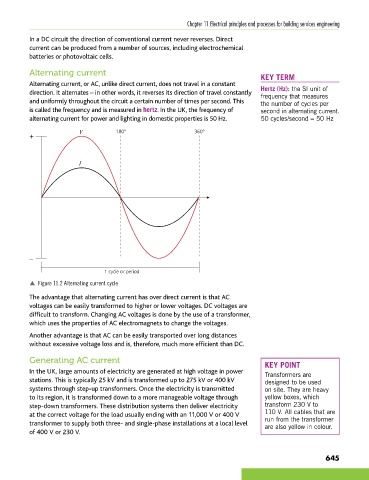
                Alternating current, or AC, unlike direct current, does not travel in a constant
                direction. It alternates – in other words, it reverses its direction of travel constantly   Hertz (Hz): the SI unit of
                                                                                           frequency that measures
                and uniformly throughout the circuit a certain number of times per second. This   the number of cycles per
                is called the frequency and is measured in hertz. In the UK, the frequency of   second in alternating current.
                alternating current for power and lighting in domestic properties is 50 Hz.  50 cycles/second = 50 Hz
                                V           180°                     360°
                +


                                I


                _


                                        1 cycle or period
                p  Figure 11.2 Alternating current cycle

                The advantage that alternating current has over direct current is that AC
                voltages can be easily transformed to higher or lower voltages. DC voltages are
                difficult to transform. Changing AC voltages is done by the use of a transformer,
                which uses the properties of AC electromagnets to change the voltages.
                Another advantage is that AC can be easily transported over long distances
                without excessive voltage loss and is, therefore, much more efficient than DC.

                Generating AC current
                                                                                            KEY POINT
                In the UK, large amounts of electricity are generated at high voltage in power   Transformers are
                stations. This is typically 25 kV and is transformed up to 275 kV or 400 kV   designed to be used
                systems through step-up transformers. Once the electricity is transmitted   on site. They are heavy
                to its region, it is transformed down to a more manageable voltage through   yellow boxes, which
                step-down transformers. These distribution systems then deliver electricity   transform 230 V to
                at the correct voltage for the load usually ending with an 11,000 V or 400 V   110 V. All cables that are
                transformer to supply both three- and single-phase installations at a local level   run from the transformer
                                                                                            are also yellow in colour.
                of 400 V or 230 V.


                                                                                                                645


        9781510416482.indb   645                                                                                    29/03/19   9:09 PM

