


Page 662 - The City and Guilds Textbook: Plumbing Book 1 for the Level 3 Apprenticeship (9189), Level 2 Technical Certificate (8202) and Level 2 Diploma (6035)
P. 662
The City & Guilds Textbook: Plumbing Book 1

                                            Temporary bonding

                                            While working in a dwelling you will no doubt have to cut into existing pipework
                                            to add a new appliance, or take it away depending on the job specification.
                                            This will mean that you will break the continuity bond between any exposed
                                            metal or bonded material and ‘earth’. It is essential that the earth continuity
                                            is maintained, and you can do this by using what is known as a temporary
                                            bond – a 10 mm  wire sheathed as earth that is attached to crocodile clips
                                                           2
                                            which you can attach at each end. Once the work has been completed you
                                            may remove the clamps and test for continuity again throughout the system.
                                            If paint is present, you must ensure that it is removed fully to enable a sound
                                            connection. There are some exceptions to bonding metallic pipes that have
                                            insulated sections at their point of entry. You MUST consult regulation 411.3.1.2
                                            of BS 7671 before cutting into or bonding any pipes.

                                            Protection methods used on electrical

                                            systems


                                            Circuit breaker
                                            The protective device in a consumer unit is also known as a circuit breaker
                                            (CB). This is an automatically operated switch designed to protect an electrical
                                            circuit from damage caused by overload or short circuit. You can also turn it
                                            off manually to isolate individual circuits. When doing so it is advised that you
                                            lock off the circuit breaker and perform the full safe isolation procedure before
                                            any work commences. While work is being carried out, the circuit breaker must
                                            remain securely isolated with warning signs posted.

                                            Residual current device
                                            A residual current device (RCD) is more sensitive than an CB, and when installed
                                            in a consumer unit its job is to protect the ‘group’ of circuits. It is larger than an
                                            CB and will have a test/reset button on its front. An RCD can be a lifesaver – it
                                            works by constantly monitoring the electric current flowing along the circuit.
                                            It is so sensitive that it can detect electricity flowing down an unintended path
                                            – such as a person. If this happens the RCD will turn off the circuit within a
                                            fraction of a second and prevent the person receiving an electric shock.

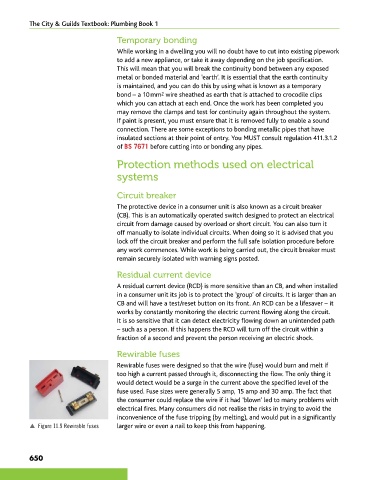
                                            Rewirable fuses
                                            Rewirable fuses were designed so that the wire (fuse) would burn and melt if
                                            too high a current passed through it, disconnecting the flow. The only thing it
                                            would detect would be a surge in the current above the specified level of the
                                            fuse used. Fuse sizes were generally 5 amp, 15 amp and 30 amp. The fact that
                                            the consumer could replace the wire if it had ‘blown’ led to many problems with
                                            electrical fires. Many consumers did not realise the risks in trying to avoid the
                                            inconvenience of the fuse tripping (by melting), and would put in a significantly
                p  Figure 11.9 Rewirable fuses   larger wire or even a nail to keep this from happening.


                650


        9781510416482.indb   650                                                                                    29/03/19   9:09 PM

