


Page 658 - The City and Guilds Textbook: Plumbing Book 1 for the Level 3 Apprenticeship (9189), Level 2 Technical Certificate (8202) and Level 2 Diploma (6035)
P. 658
The City & Guilds Textbook: Plumbing Book 1

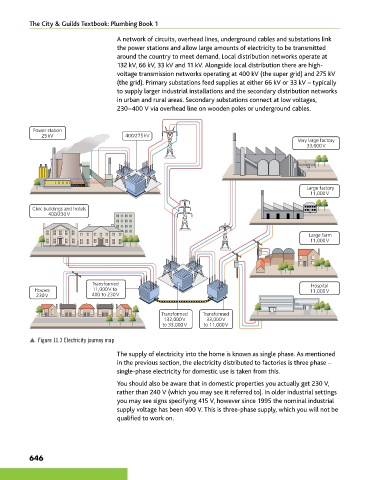
                                            A network of circuits, overhead lines, underground cables and substations link
                                            the power stations and allow large amounts of electricity to be transmitted
                                            around the country to meet demand. Local distribution networks operate at
                                            132 kV, 66 kV, 33 kV and 11 kV. Alongside local distribution there are high-
                                            voltage transmission networks operating at 400 kV (the super grid) and 275 kV
                                            (the grid). Primary substations feed supplies at either 66 kV or 33 kV – typically
                                            to supply larger industrial installations and the secondary distribution networks
                                            in urban and rural areas. Secondary substations connect at low voltages,
                                            230–400 V via overhead line on wooden poles or underground cables.


                 Power station
                    25 kV                      400/275 kV
                                                                                                       Very large factory
                                                                                                          33,000 V


                                                                                                          Large factory
                                                                                                           11,000 V

                 Civic buildings and hotels
                      400/230 V


                                                                                                           Large farm
                                                                                                           11,000 V


                                    Transformed                                                            Hospital
                  Houses            11,000 V to                                                            11,000 V
                  230 V             400 to 230 V


                                                           Transformed  Transformed
                                                           132,000 V     33,000 V
                                                           to 33,000 V  to 11,000 V

                p  Figure 11.3 Electricity journey map

                                            The supply of electricity into the home is known as single phase. As mentioned
                                            in the previous section, the electricity distributed to factories is three phase –
                                            single-phase electricity for domestic use is taken from this.
                                            You should also be aware that in domestic properties you actually get 230 V,
                                            rather than 240 V (which you may see it referred to). In older industrial settings
                                            you may see signs specifying 415 V, however since 1995 the nominal industrial
                                            supply voltage has been 400 V. This is three-phase supply, which you will not be
                                            qualified to work on.


                646


        9781510416482.indb   646                                                                                    29/03/19   9:09 PM

