


Page 85 - The City and Guilds Textbook: Plumbing Book 1 for the Level 3 Apprenticeship (9189), Level 2 Technical Certificate (8202) and Level 2 Diploma (6035)
P. 85
Chapter 1 Health and safety practices and systems

                ●  Vehicle stops must be used to prevent vehicles and plant getting too near
                   the edge and to stop a build-up in the trench of poisonous carbon monoxide
                   fumes.
                ●  The use of propane gas is prohibited as the gas is heavier than air and any
                   leak could gather at the trench floor.
                ●  Trenches and excavations must have a secure ladder (or several if the trench
                   is long) for fast emergency evacuation.
                ●  Warning notices and signs should be placed at regular intervals along the
                   trench length.


                Proprietary trench support systems
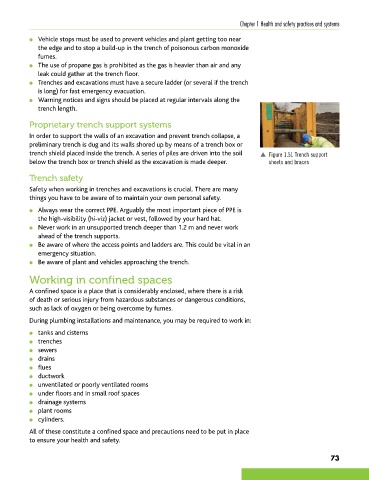
                In order to support the walls of an excavation and prevent trench collapse, a
                preliminary trench is dug and its walls shored up by means of a trench box or
                trench shield placed inside the trench. A series of piles are driven into the soil   p  Figure 1.51 Trench support
                below the trench box or trench shield as the excavation is made deeper.      sheets and braces

                Trench safety

                Safety when working in trenches and excavations is crucial. There are many
                things you have to be aware of to maintain your own personal safety.
                ●  Always wear the correct PPE. Arguably the most important piece of PPE is
                   the high-visibility (hi-viz) jacket or vest, followed by your hard hat.
                ●  Never work in an unsupported trench deeper than 1.2 m and never work
                   ahead of the trench supports.
                ●  Be aware of where the access points and ladders are. This could be vital in an
                   emergency situation.
                ●  Be aware of plant and vehicles approaching the trench.

                Working in confined spaces
                A confined space is a place that is considerably enclosed, where there is a risk
                of death or serious injury from hazardous substances or dangerous conditions,
                such as lack of oxygen or being overcome by fumes.
                During plumbing installations and maintenance, you may be required to work in:

                ●  tanks and cisterns
                ●  trenches
                ●  sewers
                ●  drains
                ●  flues
                ●  ductwork
                ●  unventilated or poorly ventilated rooms
                ●  under floors and in small roof spaces
                ●  drainage systems
                ●  plant rooms
                ●  cylinders.

                All of these constitute a confined space and precautions need to be put in place
                to ensure your health and safety.

                                                                                                                 73


        9781510416482.indb   73                                                                                     29/03/19   8:50 PM

