


Page 82 - The City and Guilds Textbook: Plumbing Book 1 for the Level 3 Apprenticeship (9189), Level 2 Technical Certificate (8202) and Level 2 Diploma (6035)
P. 82
The City & Guilds Textbook: Plumbing Book 1

                                            The remaining scaffold functions in the same way as the independent scaffold.

                                            The scaffold can be erected to existing brickwork, but is usually erected along
                                            with new building work. The working platform is supported by putlogs and not
                                            transoms. The putlog, in turn, is supported by the new brickwork by allowing
                                            the spade (flat) end of the putlog to rest flat on the brickwork. Putlogs should
                                            never be removed or the scaffold will be in danger of collapse. Putlog scaffolds
                                            should be tied to the building at least every 4 m vertically and 6 m horizontally.

                                            Access to tubular scaffolds
                                            It is usual to access a scaffold from a ladder, and provision must be made so that
                                            this can be done easily and safely. A suitable gap should be left in the handrail
                                            and toe board to allow operatives to access the scaffold. The ladder should be
                                            secured both at the top and bottom, and extend at least 1 m (approx. five rungs)
                                            above the platform.
                                            The final rung of the ladder from which the operative steps onto the platform
                                            should ideally be just above the surface of the platform. The gap left between
                                            the ladder and the guardrail should not be more than 500 mm.

                                            Guardrails and toe boards
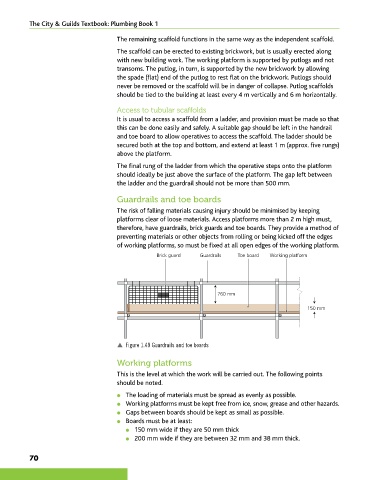
                                            The risk of falling materials causing injury should be minimised by keeping
                                            platforms clear of loose materials. Access platforms more than 2 m high must,
                                            therefore, have guardrails, brick guards and toe boards. They provide a method of
                                            preventing materials or other objects from rolling or being kicked off the edges
                                            of working platforms, so must be fixed at all open edges of the working platform.
                                                         Brick guard   Guardrails  Toe board  Working platform


                                                                             760 mm

                                                                                                          150 mm


                                            p  Figure 1.49 Guardrails and toe boards


                                            Working platforms
                                            This is the level at which the work will be carried out. The following points
                                            should be noted.
                                            ●  The loading of materials must be spread as evenly as possible.
                                            ●  Working platforms must be kept free from ice, snow, grease and other hazards.
                                            ●  Gaps between boards should be kept as small as possible.
                                            ●  Boards must be at least:
                                               ●  150 mm wide if they are 50 mm thick
                                               ●  200 mm wide if they are between 32 mm and 38 mm thick.


                70


        9781510416482.indb   70                                                                                     29/03/19   8:50 PM

