


Page 294 - APPLIED PROCESS DESIGN FOR CHEMICAL AND PETROCHEMICAL PLANTS, Volume 1, 3rd Edition
P. 294
264                       Applied Process Design for Chemical and Petrochemical  Plants

                             18°                                  Liquid Cyclone- Type Separator
                    I·
                     <D                                             The unit shown in Figure 4-49  has been used in many
                           16"  Duct
              lnle1   ,--1-------'�==�--..,...--,--,-,---'�-!--,---,
               ->,                                                process  applications  with  a  variety  of  modifications
                  �-i-----------...--1                            [ 18, 19,20]. It is effective in liquid entrainment separation,
              Fan  Discharge
              66.67  cu. ft./sec.                                 but  is  not  recommended  for  solid  particles  due  to  the
                                                                  arrangement of the  bottom  and  outlet.  The  flat bottom
                                                                  plate  serves  as  a  protection  to  the  developing liquid sur-
                                                                  face below.  This prevents re-entrainment.  In  place  of the
                                                                  plate a vortex breaker type using vertical  cross plates of 4-
                                                                  inch  to  12-inch  depth  also  is  used,  (Also  see  Reference
                                                                  [58] .)  The inlet gas connection is placed above the outlet
              Nolt: This  is  Not Drawn                           dip pipe by maintaining dimension of only a few inches at
                  to  Scale.
                                                                  point 4.  In  this  type  unit some  liquid will  creep  up  the
                                                                  walls as  the inlet velocity increases.
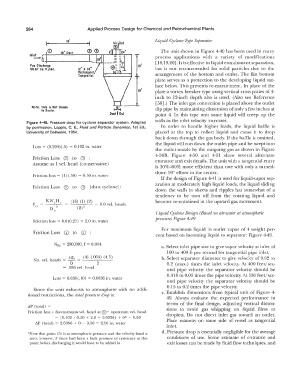
            Figure 4-48.  Pressure  drop for cyclone separator system.  Adapted
            by permission,  Lapple,  C.  E., Fluid and Particle  Dynamics,  1st Ed.,   In  order  to  handle  higher  loads,  the  liquid  baffle  is
            University of Delaware, 1954.                         placed  at  the  top  to  collect liquid  and  cause  it  to  drop
                                                                  back down  through  the gas  body.  If the baffle is omitted,
                                                                  the liquid will run down the outlet pipe and be swept into
               Loss= (0.204) (.5)  =  0.102  in. water
                                                                  the  outlet nozzle  by  the outgoing gas as  shown  in Figure
               Friction Loss  ®  to  ®  :                         4-50B.  Figure  4--50  and  4-51  show  several  alternate
               Assume as  1  vel.  head  (conservative)           entrance and exit details.  The unit with a  tangential entry
                                                                  is 30%-60%  more efficient than  one with  only  a  turned-
                                                                  down 90°  elbow in the center.
               Friction loss =  (1) (.50)  =  0.50 in. water
                                                                    If the design of Figure 4-41  is used for liquid-vapor sep-
                                                                  aration at moderately high liquid loads,  the liquid sliding
               Friction Loss  ®  to  (D  (thru cyclone):
                                                                  down  the walls  in  sheets  and  ripples  has  somewhat of a
                                                                  tendency  to  be  torn  off  from  the  rotating  liquid  and
                    KW.I-I      5     2                           become re-entrained in the upward gas movement.
                        '   c   (1 )  (l)  ( )  =  8.0 vel.  heads
                      D  2       (2)2
                        e
                                                                  Liquid Cyclone Design  (Based on air-toater at atmospheric
                                                                  pressure) Figure  4-49
               Friction loss =  8.0(0.25)  =  2.0 in. water
               Friction Loss  ©  to  ®  :                            For maximum  liquid  in  outlet vapor of 4 weight per-
                                                                  cent based on incoming liquid to  separator:  Figure 4-49.
                        NRc  =  280,000, f =  0.004
                                                                     a. Select inlet pipe size to give vapor velocity at inlet of
                                                                       100 to 400 ft per second for tangential pipe inlet.
                              4fL   (4)  (.004)  (4.5)               b.  Select separator diameter to  give velocity of 0.02  to
               No.  ve  I  I  .  1ea  s  =  -  =  ------
                         d
                              0           2                            0.2  (max.)  times  the  inlet velocity.  At 400 feet/sec-
                           =  . 036 vel.  head
                                                                       ond  pipe  velocity  the  separator velocity  should  be
                                                                       0.018 to 0.03 times the pipe velocity.  At 130 feet/sec-
                       Loss  =  0.036(.10)  =  0.0036 in. water
                                                                       ond  pipe  velocity  the  separator velocity  should  be
                                                                       0.15 to 0.2 times the pipe velocity.
               Since  the  unit exhausts  to  atmosphere  with  no  addi-
             tional  restrictions,  the  total pressure drop is:     c.  Establish  dimensions  from  typical  unit of Figure  4-
                                                                       49.  Always  evaluate  the  expected  performance  in
                                                                       terms  of the final  design,  adjusting vertical  dimen-
             ti.P  (total)  =                                          sions  to  avoid  gas  whipping  on  liquid  films  or
             Friction loss + downstream vel. head at®- upstream vel.  head   droplets.  Do  not  direct inlet  gas  toward  an  outlet.
                        =  (0.102 +  0.50  +  2.0  +  0.0036)  +  O*  - 0.50
                ti.P  (total)  = 2.6056 +  0  --  0.50  =  2.10 in. water   Place  manway  on  same  side  of vessel  as  tangential
                                                                       inlet.
             *Note that point  (5)  is at atmospheric pressure  and the velocity head is   d. Pressure drop is essentially negligible for the average
             zero;  however,  if there  had  been a  back pressure  or resistance  at this   conditions  of use.  Some  estimate  of entrance  and
             point before discharging it would have  to be added in.   exit losses can be made by fluid flow techniques, and

