


Page 295 - APPLIED PROCESS DESIGN FOR CHEMICAL AND PETROCHEMICAL PLANTS, Volume 1, 3rd Edition
P. 295
Mechanical  Separations                                   265


                 c                   1
           �---;_-L-  ,c;...._,.;,...;.._--=-_,_-_...,.,f
            c
           ·e
           -N                       Outlet Dip Pipe
            �                                                                                    CD
           a
           s                                                                                     @)  Tangential  to
           a                                                                                         shell wall
           �
                                        Inlet
                                      •4-·-
                                       (Also  Dtsigned  lo  Wrap
                            "'t-"T"T.,-:r�-t
            c
           ·e                           90° lo  180° Araund Vt11tl
            �              0
           -N                           lo  glH Tangential  Inlet).
            0
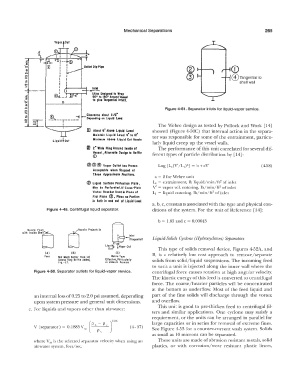
           ..,                                                        Figure 4-51. Separator inlets for liquid-vapor service  .
           a
           :::,.
           a          �              Clearance  about  1112"
                                -I
           s         --  -- ,  -----   Depending on  Liqaid  Load
               [i]
                           1                                       The Webre  design  as  tested by  Pollock and Work  [14]
                                     ffi  About  6" AboH  Liquid  Ltwel   showed  (Figure 4-50C)  that internal  action in the  separa-
                                        Maintain  Liquid  Lent  4" to  12"   tor was responsible for some of the entrainment,  particu-
                       Liquid�Ou!       Mini111u111  AboH  Liquid  Out  Nozzle
                                                                larly liquid creep up the vessel walls.
                                     IZI  2" Wide  Ring  Around  l11id1  af   The performance of this unit correlated for several dif-
                                        V1111I  , Alternate  Dtsign  to  Baffle   ferent types of particle distribution  by  [14]:
                                        ©
                                     © @® Vapor  Outlet hos Pronn                                             ( 4-58)
                                        Acceptable  whn  Stopped  at
                                        Thu  Appro1i111ate  Positions.
                                                                 a  =  2  for Webre  unit
                                                                                            2
                                     @  Liquid  Surface  Protection  Plott,   L,.  =  entrainment,  lb liquid/min/ft of inlet
                                                                                            2
                                        1101  b1  Perforated.If Cron-Plate   V' =  vapor vel.  entering,  lb/min/ft of inlet
                                        Vortu Brtoktr Uud in  Platt of   L 1  =  liquid  entering, lb/min/ft of inlet
                                                                                         2
                                        Flot  Plall  @, Place  10  Portion
                                        i1  Both  in  ond  out  of  Liquid  Ln1I.
                                                                a, b, c, constants associated with the type and physical con-
                     Figure 4-49.  Centrifugal  liquid separator.   ditions of the system.  For the unit of Reference  [14]:
                                                                   b  =  1.85  and c  =  0.00643
          """ '"'"'  '"'LJ                           -          Liquid-Solids Cyclone  (Hydrocyclones)  Separators
            Nonie  Flush
                                                       Inlet
                                                       (Tonqenliall
                                             Li ��� t  t  Vapor  Ou!
                                                                   This  type of solids  removal  device,  Figures  4-52A,  and
                    (Al        IB)               IC)
                   Poor   Nol  Much  Betltr  lhon  IA)   Webre  T1pe   B,  is  a  relatively  low  cost  approach  to  remove/separate
                         Unlen Ring  Baffle  Added,   Effectivt  • Particularf y   solids from  solid/liquid  suspensions.  The  incoming feed
                         Fig.·  27.          in  Vacuum  Service
                                                                to  such a  unit is  injected  along  the  inner wall  where  the
               Figure 4-50.  Separator outlets for liquid-vapor service.   centrifugal  force causes rotation at high angular velocity.
                                                                The kinetic energy of this feed is converted to centrifugal
                                                                force.  The  coarse/heavier particles will  be  concentrated
                                                                at the  bottom  as  underflow.  Most of the feed  liquid and
               an internal loss of0.25 to 2.0 psi assumed, depending   part of the fine  solids will  discharge  through  the vortex
               upon system pressure and general  unit dimensions.   and overflow.
             e.  For liquids and vapors other than air-water:      This unit is good  lo  pre-thicken  feed  to centrifugal fil-
                                                                ters  and  similar  applications.  One  cyclone  may  satisfy  a
                                                                requirement,  or the  units  can be arranged  in  parallel for
                                      [  PL  - P,.   )0.25      large capacities or in series for removal  of extreme fines.
               V  (separator)  =  0.1885 V sn   -      ( 4- 57)
                                       --p- "                   See Figure  4-53  for a counter-current wash system.  Solids
                                                                as small as  10 microns can be separated.
               where V,a  is the selected separator velocity when  using an   These units are made of abrasion resistant metals, solid
               air-water system,  feet/sec.                     plastics,  or  with  corrosion/wear  resistant  plastic  liners,

