


Page 301 - APPLIED PROCESS DESIGN FOR CHEMICAL AND PETROCHEMICAL PLANTS, Volume 1, 3rd Edition
P. 301
Mechanical Separations                                     271


                                                                                           All WILDED  CONSTIUCTION.  Inlet  ond  01,o1let
                                                                                           duct  connution1  are  weld.cl  ond  Ron�d.
                                      AUTOMATIC  CON-
                                      J 10  LS  re;ulote
                                      wo1h-down  of moi,-
                                      lure  elirriinotor  bed
                                      ond  opero!lon  of
                                      1ludge  c.onveyor.
                                                                                                     PROTECTIVE  COATING
                                                                                                     prolec.h  all  funclionol
                                                                                                     C  1teel I  componenh.
                                                                                      U------===--  Red'Jce,  wear,  ero1ion
                                                                                                     or corro,ion  from  wotet
                                                                                                     or dull.
                                      STAINLESS  sna  1crHn
                                      �:o;t�:!'!�:ton, '---------+-,;·  ,111.-!lll'ill!la,'!��
                                     SELF  CLEANING  detililn  prennt1  c.orro1iwe  build-
                                     up. There ore no baffles or bladH to wear within
                                     eolleclion  area.  Entire  oreo  ii oC"tiwe -  no  dead
                                     area, for  accumulation  of  dutt,
                                     Overflow-----------
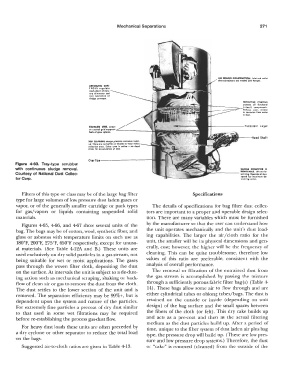
       Figure  4-63.  Tray-type  scrubber
       with  continuous  sludge  removal.
       Courtesy  of  National  Dust  Collec-
       tor Corp.


          Filters of this type or class may be of the large bag filter          Specifications
        type for large volumes of low pressure dust laden gases or
        vapor,  or of the generally smaller cartridge  or pack types   The details  of specifications  for bag  filter dust collec-
        for  gas/vapors  or  liquids  containing  suspended  solid   tors are important to a proper and operable design selec-
        materials.                                           tion.  There  are  many  variables which  must  be  furnished
          Figures  4-65,  4-66,  and  4-67  show  several  units  of the   by  the manufacturer so that the user can understand how
        bag. The bags may be of cotton, wool, synthetic fiber,  and   the unit operates  mechanically  and  the  unit's  dust  load-
        glass  or asbestos  with  temperature  limits  on  such  use  as   ing  capabilities.  The  larger  the  air/cloth  ratio  for  the
        I80°F,  200°F,  275°F,  650°F respectively,  except for unusu-   unit,  the smaller will be  its  physical  dimensions and gen-
        al  materials.  (See  Table  4-12A  and  B.)  These  units  are   erally,  cost;  however,  the  higher will  be  the  frequency  of
        used exclusively on dry solid particles in a gas stream, not   cleaning.  This  can  be  quite  troublesome,  therefore  low
        being  suitable  for  wet  or  moist  applications.  The  gases   values  of  this  ratio  are  preferable,  consistent  with  the
        pass  through  the woven  filter cloth,  depositing  the  dust   analysis of overall  performance.
        on the surface. At intervals the unit is subject to a de-dust-   The  removal  or filtration  of the  entrained  dust  from
        ing action such as mechanical  scraping,  shaking or back-   the  gas  stream  is  accomplished  by  passing  the  mixture
        flow of clean air or gas  to remove the dust from the cloth.   through a sufficiently porous fal,ric filter bag(s)  (Table 4-
        The  dust  settles  to  the  lower section  of the  unit  and  is   14). These  bags  allow  some  air to  flow  through  and  are
        removed.  The  separation  efficiency  may  be 99%+,  but is   either cylindrical  tubes or oblong tubes/bags.  The dust is
        dependent upon  the  system  and  nature  of the  particles.   retained  on  the  outside  or  inside  (depending  on  unit
        For extremely  fine  particles  a  precoat of dry dust similar   design)  of the bag  surface and  the  small  spaces  between
        to  that  used  in  some  wet  filtrations  may  be  required   the  fibers  of the  cloth  ( or felt). This  dry  cake  builds  up
        before re-establishing the process gas-dust flow.    and  acts  as  a  pre-coat  and  then  as  the  actual  filtering
                                                             medium as  the dust particles build  up.  After a  period of
          For heavy dust loads  these units are often  preceded by   time, unique to the filter system of dust laden air plus bag
        a dry  cyclone or other separator to reduce  the total  load   type, the pressure drop will build up.  (These are low pres-
        on  the bags.                                        sure and low pressure drop systems.)  Therefore,  the dust
          Suggested air-to-cloth  ratios are given in Table 4-13.   or  "cake"  is  removed  (cleaned)  from  the  outside  of the

