


Page 84 - APPLIED PROCESS DESIGN FOR CHEMICAL AND PETROCHEMICAL PLANTS, Volume 1, 3rd Edition
P. 84
68                        Applied Process Design for Chemical  and Petrochemical Plants

                            PIPE  DIAMETER  IN  FEET,  0          lished values  of references  [l, 2,  3], and cannot be used
                      I   2  ·�  !l.:5.6  .8  I   2   3  •   I  6   ID   20  25
                   .0:5                                  .07      with  the values  presented  in Perry's  Handbook  [5], as Per-
                   .04
                   .03             "'                    .06      ry's values for,  f,  are  one-fourth  times  the values  cited in
                   .02         '                         .05      this  chapter.  It is essential  to  use f values with  the  corre-
                                                                  sponding formulas offered in the appropriate  text.
                   .OI   '         '                     04   II)    The  Colebrook  equation  [6,  58]  is  considered  a  reli-
                  .008                                   .o�  �
                  .006           IV  STE£  D                ii:   able  approach  to  determining  the  friction  factor,  f
                  .005  "              "                 .03   ::c
                                                            0
                  .004                                      :::>   (Moody factor)
                  .003          WOOD                        0
                                                            Q:
                         '     J,STAVE             ..  •  t-   .025
                  .002                       '      '0,t  ,   IIJ"
                                                            u
                               "                            z                   (-E-+�J
                                                            Ill
              wlo   .001                             '--   .02   ..J   _l_=-Jog                                (2 - 18)
                                                                     Jr
                                                            :::>
              ..,   .  0008        �  .....             .()18   m             IO  3.70   RC  [i
              (fl
                                                            Q:
              (fl
                                                            :::,
                  .0006
              z   .0005                              I'<    I-
              ::c   .0004        D                      06  ..,
                                  h'-1t  'P,i;
              C)               "    0-f.,.  c.              I-
              :::>   .0003       i'\lj
                                          ,,
              0                   (}.  B::'•   "'  ,. e;,-   �   t-   Ill
              a::   .0002          "   ;:t:�  !<,c   '   .0!4   ..J
                                                            D.
                                         0
                                                            0
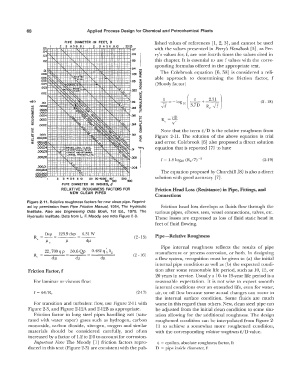
              "'  >                 "'  ,-i-  >---  ?<j'° � o   :I!   Note  that the term E/D  is the relative  roughness  from
                                                            u
              �    .0001               �-               .02   Q:   Figure  2-11.  The  solution  of the  above  equation  is  trial
                                                    .  '--
              ..J  .000,08                      .   o«rd,. l'l   0
              IIJ                                           ....
              a::   .000,06  r-,                    ��            and error.  Colebrook  [ 6]  also  proposed a direct solution
                 .000,05                          ,
                 .000,04     BR  AS9, LEAD, GLASS,   OQ_   .()I   '+,   equation  that is  reported  [7]  to  have
                                                     T,
                 .000,03   I'<'   CE NTRIF\JGAU.Y  .. SPUN   .  C,,.i:,.
                             CEMENT ANO  BITUMlflJS
                                                     ··,�
                 .000,02   '   UMNGS, TRANSITE, ETC.   !, �   .009   f =  1.8 log 10  (Rj7)- 2                  (2-19)
                                                    •.
                 .000,01       �o  Oo      I            .008
                .000,008          00  ��,            =  ?
                .000,006           I'<                               The equation proposed by Churchill  [8]  is also a direct
                .000,00S                                           solution with good accuracy  [7].
                     I   2   3  4  5 s  8  10   20  30 40 � 0 eolOO   200
                                                       300
                           PIPE  DIAMETER  IN  INCHES, d
                           RELATIVE  ROUGHNESS  FACTORS  FOR       Friction Head Loss (Resistance) in Pipe, Fittings,  and
                               NEW  CLEAN  PIPES
                                                                   Connections
             Figure 2-11. Relative roughness factors for new clean pipe.  Reprint-
             ed  by  permission  from  Pipe  Friction  Manual,  1954,  The  Hydraulic   Friction  head  loss  develops  as  fluids flow  through  the
             Institute.  Also  see  Engineering  Data  Book,  1st  Ed.,  1979,  The   various pipes,  elbows,  tees, vessel connections, valves,  etc.
             Hydraulic Institute.  Data from  L.  F.  Moody,  see note Figure 2-3.   These  losses  are  expressed  as  loss  of fluid  static  head  in
                                                                   feet of fluid flowing.
                    Dvp   123.9 dvp   6.31 W
               R  =--=            =---                    (2-15)   Pipe-Relative Roughness
                 e
                    µc       µ       dµ
                                                                     Pipe  internal  roughness  reflects  the  results  of  pipe
                    22, 700 q p   50.6 Qp   0.482 q �  Si;         manufacture  or process  corrosion,  or both.  In  designing
               R"      dµ        du         dµ           (2 -16)   a flow system, recognition must be given  to  (a)  the initial
                                                                   internal pipe condition as well as  (b)  the expected condi-
             Friction Factor,  f                                   tion  after some reasonable life  period, such as  10,  15,  or
                                                                   20 years in service.  Usually a  10- to  15-year life  period is a
               For laminar or viscous flow:                        reasonable  expectation.  It is  not wise  to  expect smooth
                                                                   internal  conditions over an extended life,  even for water,
               f =  64/Re                                 (2-17)   air,  or oil flow  because some actual  changes  can occur in
                                                                   the  internal  surface  condition.  Some  fluids  are  much
               For transition and  turbulent flow,  use Figure  2-11 with   worse in this regard than others. New,  clean steel pipe can
             Figure 2-3, and Figure 2-12A and 2-128 as appropriate.   be adjusted from the initial clean condition to some situ-
               Friction  factor  in  long  steel  pipes  handling wet  (satu-   ation  allowing  for  the additional  roughness.  The  design
             rated  with  water vapor)  gases  such  as  hydrogen,  carbon   roughened condition  can be interpolated from Figure  2-
             monoxide,  carbon  dioxide,  nitrogen,  oxygen  and  similar   1 l  to  achieve  a  somewhat  more  roughened  condition,
             materials  should  be  considered  carefully,  and  often   with the corresponding relative roughness £/D value.
             increased by a factor of 1.2 to 2.0 to accoun  l for corrosion.
               Important Note:  The  Moody  [l]  friction  factors  repro-   E  =  epsilon, absolute roughness factor,  ft
             duced in this text (Figure 2-3)  are consistent  with the pub-   D  =  pipe inside diameter,  ft

