


Page 80 - APPLIED PROCESS DESIGN FOR CHEMICAL AND PETROCHEMICAL PLANTS, Volume 1, 3rd Edition
P. 80
64                        Applied Process Design for Chemical  and Petrochemical  Plants

                                                                       TUBE  OD                IPS


                                              ...


                                              •


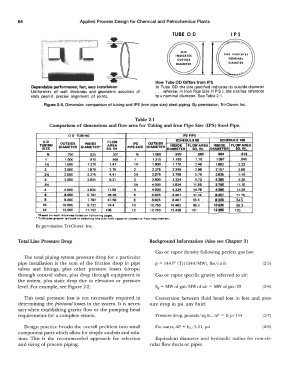
              Dependable performance; fast, easy installation    How Tube OD Differs from  IPS
                                                                 In  Tube  OD  the size  specified  indicates  its  outside diameter
              Uniformity  of  wall  thickness  and  geometric  accuracy  of   ...  whereas  in  Iron Pipe Size  (I.PS ), the size has  reference
              ends  permit  precise  alignment  of joints.      to a  nominal diameter.  See Table 2-1.
                   Figure 2-9.  Dimension comparison of tubing and IPS (iron pipe size)  steel  piping.  By permission,  Tri-Clover,  Inc.


                                                        Table 2-1
                     Comparison of dimensions and flow area for Tubing and Iron Pipe Size (IPS) Steel Pipe.
                             OD  TUBING                                     IPS PIPE
                   OD                        FLOW             OUTSIDE    SCHEDULE tlS      SCHEDULE 106
                          OUTSIDE
                                    INSIDE
                                                       IPS
                 TUBING   DIAMETER  DIAMETER•   AREA   PIPE SIZE  DIAMETER   INSIDE   FLOW AREA   INSIDE   FLOW AREA
                  SIZE                       SO.IN.                  DIAMETER   SO. IN.   DIAMETER   SO.IN.
                    "       .750      .625     .307      %     1.060    .920      .665    .884     .814
                   1        1.000     .870     .595     1      1.315    1.185    1.10    1.097     .!Mtl
                   1i.     1.500     1.370    1.47      1%     1.900    1.770    2.46    1.882    2.22
                   2       2.000     1.870    2.75      2      2.376    2.246    3.96    2.167    3.66
                   2�      2.500     2.370    4.41      2%     2.876    2.709    6.76    2.836     6.45
                   3       3.000     2.834    6.31      3      3.!500   3.334    8.73    3.280    8.38
                   3%       .  .  .   .  .  .   ...     3%     4.000    3.834   11.66    3.780    11.10
                   4       4.000     3.834   11.56      4      4.500    4.334   14.75    4.280    14.26
                   •       8.000     6.782   26.26      8      8.826   8.407    32.24    8.367    31.76
                   8       8.000     7.782   47.56      8      8.826   8.407    66.6     8.329    64.5
                   10      10.000    9.732   74.4      10     10.760   10.482   88.3    10.420    85.3
                   12      12.000   11.732   108.      12     12.750   12.438   121.    12.390   120.
                 'Biiied on well  thlckn"'  lltted on following pes,11.
                •'  lndlc•tet gr•t•r l•tltud• In 1etectlng lln• tlze with capacity  clotest to flow  requi,.ment.
                By permission Tri-Clover,  Inc.


        Total Line Pressure Drop                              Background Information (Also see Chapter 3)

                                                                 Gas or vapor density following perfect gas law:
           The total  piping system  pressure drop for a  particular
        pipe  installation  is  the  sum  of the  friction  drop  in  pipe   p  =  144 P'  (T)(l544/MW), lbs/cu ft   (2-5)
        valves  and  fittings,  plus  other  pressure  losses  (drops}
         through  control  valves,  plus drop  through equipment in   Gas or vapor specific gravity referred to air:
         the system,  plus  static  drop  due  to  elevation  or pressure
         level.  For example, see Figure 2-2.                   Sg  =  MW of gas/MW of air =  MW of gas/29   (2-6)

           This  total  pressure  loss  is  not necessarily  required  in   Conversion  between  fluid  head  loss  in  feet and  pres-
         determining  the frictional losses in  the system.  It is neces-   sure drop in psi, any fluid:
         sary when  establishing gravity  flow  or the pumping head
         requirements for a complete system.                     Pressure drop,  pounds/sq in., �p =  h1.p/144   (2-7)

           Design practice  breaks  the overall  problem  into small   For water,  �p  =  hL/2.31, psi      (2-8)
         component parts which allow for simple analysis and solu-
         tion.  This  is  the  recommended  approach  for  selection   Equivalent diameter and  hydraulic  radius for non-cir-
         and sizing of process piping.                        cular flow ducts or pipes

