


Page 152 - English for Writing Research Papers
P. 152
134

              The extract highlights that using a mixture of  we  and passive enables you to choose
            the focus of your phrase.  The candidates were divided  puts the focus on the candi-
            dates, whereas  We then used the results  focuses on what we did (i.e. our role is being
            emphasized). Mixing  we  and the passive also creates variety for the reader. Note
            also that the active is also sometimes used ( Candidates then underwent a second
            test ), thus highlighting that in some cases it is still possible to write in an impersonal
            way using active forms.


            7.9      Make good use of references

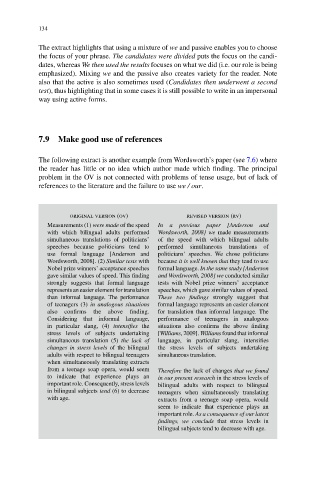
              The following extract is another example from Wordsworth’s paper (see   7.6    ) where

            the reader has little or no idea which author made which finding. The principal
            problem in the OV is not connected with problems of tense usage, but of lack of
            references to the literature and the failure to use  we / our .


                        original version (ov)           revised version (rv)
                Measurements (1)  were made  of the speed      In a previous paper [Anderson and
              with which bilingual adults performed   Wordsworth, 2008] we  made measurements
              simultaneous translations of politicians’   of the speed with which bilingual adults
              speeches because politicians tend to   performed simultaneous translations of
              use formal language [Anderson and   politicians’ speeches. We chose politicians
              Wordsworth, 2008]. (2)  Similar tests  with   because  it is well known that  they tend to use
              Nobel prize winners’ acceptance speeches   formal language.  In the same study [Anderson
              gave similar values of speed. This fi nding   and Wordsworth, 2008] we  conducted similar
              strongly suggests that formal language   tests with Nobel prize winners’ acceptance
              represents an easier element for translation   speeches, which gave similar values of speed.

              than  informal language. The performance     These two findings  strongly suggest that
              of teenagers (3)  in analogous situations    formal language represents an easier element
              also confirms the above fi nding.   for translation than informal language. The

              Considering that informal language,   performance of teenagers in analogous
              in particular slang, (4)  intensifi es   the   situations also confirms the above fi nding

              stress levels of subjects undertaking   [ Williams , 2009].  Williams  found that informal
              simultaneous translation (5)  the lack of   language, in particular slang, intensifi es
              changes in stress levels  of the bilingual   the stress levels of  subjects undertaking
              adults with respect to bilingual teenagers   simultaneous translation.
              when simultaneously translating extracts
              from a teenage soap opera, would seem     Therefore  the lack of changes  that we found
              to indicate that experience plays an   in our present research  in the stress levels of
              important role. Consequently, stress levels   bilingual adults with respect to bilingual
              in bilingual subjects  tend  (6) to decrease   teenagers when simultaneously translating
              with age.                      extracts from a teenage soap opera, would
                                             seem to indicate that experience plays an
                                             important role.  As a consequence of our latest
                                             findings, we conclude  that stress levels in

                                             bilingual subjects tend to decrease with age.

