


Page 81 - English for Writing Research Papers
P. 81
63


            4.7   When expressing your aims, consider dividing up a long
                 sentence into shorter parts
             Often you need to explain the rationale for adopting a particular procedure or line of
            research. To do this, writers typically use expressions such as  in order to, with the
            purpose of, with the aim to, in an attempt to.


              This is fine if you can express the rationale in a few words, as in this example:
                In order to test our hypothesis, we sampled a random selection of documents.

              But if your rationale is longer than about 15 words, you probably need to split the
            sentence up, as shown below:


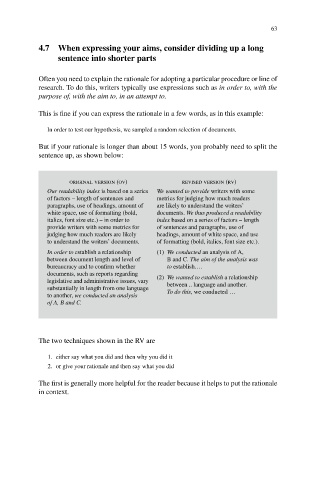
                       original version (ov)           revised version (rv)
                 Our readability index  is based on a series      We wanted to provide  writers with some
              of factors – length of sentences and   metrics for judging how much readers
              paragraphs, use of headings, amount of   are likely to understand the writers’
              white space, use of formatting (bold,   documents.  We thus produced a readability
              italics, font size etc.) – in order to   index  based on a series of factors – length
              provide writers with some metrics for   of sentences and paragraphs, use of
              judging how much readers are likely   headings, amount of white space, and use
              to understand the writers’ documents.   of formatting (bold, italics, font size etc.).
                 In order to  establish a relationship    (1)    We conducted  an analysis of A,
              between document length and level of   B and C.  The aim of the analysis was
              bureaucracy and to confi rm whether   to  establish….
              documents, such as reports regarding    (2)    We wanted to establish  a relationship
              legislative and administrative issues, vary   between .. language and another.
              substantially in length from one language     To do this , we conducted …
              to another,  we conducted an analysis
              of A, B and C.


                    The two techniques shown in the RV are

                    1.   either say what you did and then why you did it


                  2.   or give your rationale and then say what you did


             The first is generally more helpful for the reader because it helps to put the rationale

            in context.

