


Page 226 - Basic Japanese
P. 226
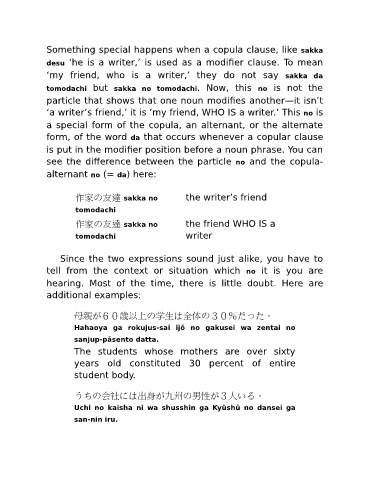
Something special happens when a copula clause, like sakka
                desu ‘he is a writer,’ is used as a modifier clause. To mean

                ‘my  friend,  who  is  a  writer,’  they  do  not  say  sakka  da
                tomodachi  but  sakka  no  tomodachi.  Now,  this  no  is  not  the

                particle that shows that one noun modifies another—it isn’t
                ‘a writer’s friend,’ it is ‘my friend, WHO IS a writer.’ This no is

                a special form of the copula, an alternant, or the alternate
                form, of the word da that occurs whenever a copular clause

                is put in the modifier position before a noun phrase. You can
                see the difference between the particle  no and the copula-

                alternant no (= da) here:


                          作家の友達 sakka no                      the writer’s friend
                          tomodachi


                          作家の友達 sakka no                      the friend WHO IS a
                          tomodachi                           writer


                     Since the two expressions sound just alike, you have to

                tell  from  the  context  or  situation  which  no  it  is  you  are
                hearing.  Most  of  the  time,  there  is  little  doubt.  Here  are

                additional examples:


                          母親が60歳以上の学生は全体の30%だった。

                          Hahaoya  ga  rokujus-sai  ijō  no  gakusei  wa  zentai  no
                          sanjup-pāsento datta.
                          The  students  whose  mothers  are  over  sixty

                          years  old  constituted  30  percent  of  entire
                          student body.


                          うちの会社には出身が九州の男性が3人いる。
                          Uchi  no  kaisha  ni  wa  shusshin  ga  Kyūshū  no  dansei  ga

                          san-nin iru.

