


Page 280 - Basic Japanese
P. 280
one of the other digits. The even tens (twenty, thirty, forty,

                etc.)  are  compound  words  consisting  of  one  of  the  digits
                plus jū ‘ten.’ In other words, the Japanese reads 13 as ‘ten-

                three’  and  30  as  ‘three-ten.’  The  hundreds  and  thousands
                work  like  the  tens:  300  is  3  x  100  (san-byaku),  3000  is  3  x

                1000  (san-zen).  You  will  notice  some  changes  in  the
                pronunciation of the individual elements when they occur in

                certain  compounds.  These  are  summarized  below  in  note
                6.8. Other numerals (like 21, 103, 1007, 2326) consist of a

                phrase  of  several  words:  sanzen  sanbyaku  sanjū  san  ‘3333.’
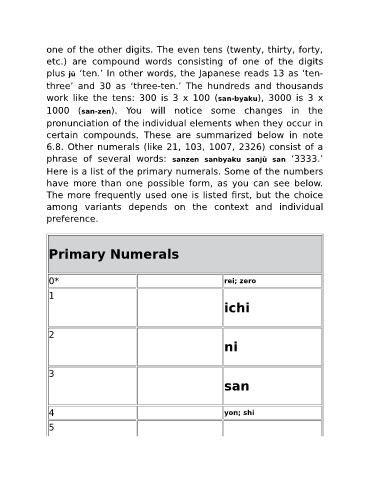
                Here is a list of the primary numerals. Some of the numbers

                have  more  than  one  possible  form,  as  you  can  see  below.
                The more frequently used one is listed first, but the choice

                among  variants  depends  on  the  context  and  individual
                preference.


                 Primary Numerals


                 0*                                                        rei; zero

                 1
                                                                           ichi


                 2
                                                                           ni


                 3
                                                                           san


                 4                                                         yon; shi

                 5

