


Page 424 - Basic Japanese
P. 424
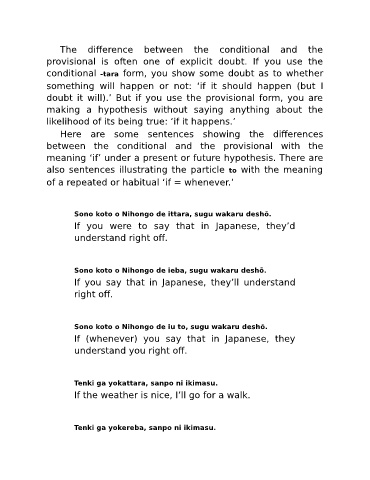
The  difference  between  the  conditional  and  the

                provisional  is  often  one  of  explicit  doubt.  If  you  use  the
                conditional -tara form, you show some doubt as to whether

                something  will  happen  or  not:  ‘if  it  should  happen  (but  I
                doubt it will).’ But if you use the provisional form, you are

                making  a  hypothesis  without  saying  anything  about  the
                likelihood of its being true: ‘if it happens.’

                     Here  are  some  sentences  showing  the  differences
                between  the  conditional  and  the  provisional  with  the

                meaning ‘if’ under a present or future hypothesis. There are
                also sentences illustrating the particle  to with the meaning
                of a repeated or habitual ‘if = whenever.’


                          Sono koto o Nihongo de ittara, sugu wakaru deshō.

                          If  you  were  to  say  that  in  Japanese,  they’d
                          understand right off.


                          Sono koto o Nihongo de ieba, sugu wakaru deshō.
                          If  you  say  that  in  Japanese,  they’ll  understand

                          right off.


                          Sono koto o Nihongo de iu to, sugu wakaru deshō.
                          If  (whenever)  you  say  that  in  Japanese,  they
                          understand you right off.


                          Tenki ga yokattara, sanpo ni ikimasu.
                          If the weather is nice, I’ll go for a walk.


                          Tenki ga yokereba, sanpo ni ikimasu.

