


Page 420 - Basic Japanese
P. 420
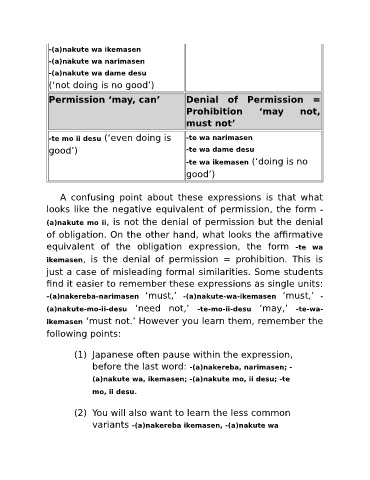
-(a)nakute wa ikemasen

                 -(a)nakute wa narimasen
                 -(a)nakute wa dame desu
                 (‘not doing is no good’)


                 Permission ‘may, can’                         Denial  of  Permission  =
                                                               Prohibition             ‘may         not,
                                                               must not’

                 -te mo ii desu (‘even doing is                -te wa narimasen

                 good’)                                        -te wa dame desu
                                                               -te wa ikemasen (‘doing is no

                                                               good’)


                     A  confusing  point  about  these  expressions  is  that  what
                looks like the negative equivalent of permission, the form -

                (a)nakute mo ii, is not the denial of permission but the denial
                of obligation. On the other hand, what looks the affirmative

                equivalent  of  the  obligation  expression,  the  form  -te  wa
                ikemasen,  is  the  denial  of  permission  =  prohibition.  This  is

                just a case of misleading formal similarities. Some students
                find it easier to remember these expressions as single units:

                -(a)nakereba-narimasen  ‘must,’  -(a)nakute-wa-ikemasen  ‘must,’  -

                (a)nakute-mo-ii-desu  ‘need  not,’  -te-mo-ii-desu  ‘may,’  -te-wa-
                ikemasen ‘must not.’ However you learn them, remember the

                following points:


                          (1) Japanese often pause within the expression,

                                before the last word: -(a)nakereba, narimasen; -
                                (a)nakute wa, ikemasen; -(a)nakute mo, ii desu; -te

                                mo, ii desu.


                          (2) You will also want to learn the less common

                                variants -(a)nakereba ikemasen, -(a)nakute wa

