


Page 477 - Basic Japanese
P. 477
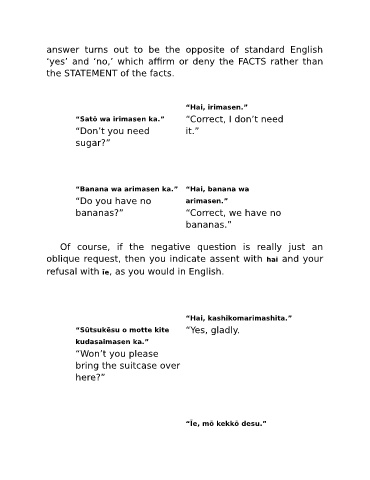
answer  turns  out  to  be  the  opposite  of  standard  English

                ‘yes’ and ‘no,’ which affirm or deny the FACTS rather than
                the STATEMENT of the facts.


                                                              “Hai, irimasen.”

                          “Satō wa irimasen ka.”              “Correct, I don’t need
                          “Don’t you need                     it.”
                          sugar?”


                          “Banana wa arimasen ka.”            “Hai, banana wa
                          “Do you have no                     arimasen.”

                          bananas?”                           “Correct, we have no
                                                              bananas.”


                     Of  course,  if  the  negative  question  is  really  just  an
                oblique request, then you indicate assent with hai and your

                refusal with īe, as you would in English.


                                                              “Hai, kashikomarimashita.”
                          “Sūtsukēsu o motte kite             “Yes, gladly.

                          kudasaimasen ka.”
                          “Won’t you please
                          bring the suitcase over

                          here?”


                                                              “Īe, mō kekkō desu.”

