


Page 242 - Dungeon Master's Guide
P. 242
•

               RESOLUTION AND  CONSEQUENCES                      EXPLORATION
               You determine the consequences of attack rolls, ability   This section provides guidance for running exploration,
               checks, and saving throws. In most cases, doing so is   especially travel, tracking, and visibility.
               straightforward. When an attack hits, it deals damage.
               When a creature fails a saving throw, the creature   USING A  MAP
               suffers a harmful effect. When an ability check equals or
                                                                 Whatever environment the adventurers are exploring,
               exceeds the DC, the check succeeds.
                                                                 you can use a map to follow their progress as you relate
                 As a DM, you have a variety of flourishes and
                                                                 the details of their travels. In a dungeon, tracking
               approaches you can take when adjudicating success and
                                                                 movement on a map lets you describe the branching
               failure to make things a little less black-and-white.
                                                                 passages, doors, chambers, and other features the
                                                                 adventurers encounter as they go, and gives the players
               SuccEss AT A  CosT
                                                                 the opportunity to choose their own path. Similarly, a
               Failure can be tough, but the agony is compounded
                                                                 wilderness map can show roads, rivers, terrain, and
               when a character fails by the barest margin. When a
                                                                 other features that might guide the characters on their
               character fails a roll by only 1 or 2, you can allow the
                                                                 travels- or lead them astray.
               character to succeed at the cost of a complication or
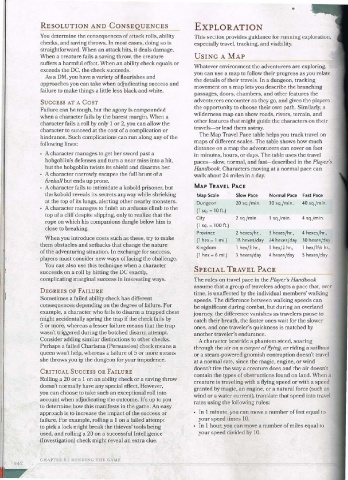
                                                                   The Map Travel Pace table helps you track travel on
               hindrance. Such complications can run along any of the
                                                                 maps of different scales. The table shows how much
               following lines:
                                                                 distance on a map the adventurers can cover on foot
                 A character manages to get her sword past a     in minutes, hours, or days. The table uses the travel
                 hobgoblin's defenses and turn a near miss into a hit,   paces- slow, normal, and fast-described in the Player's
                 but the hobgoblin twists its shield and disarms her.   Handbook. Characters moving at a normal pace can
                 A character narrowly escapes the full brunt of a   walk about 24 miles in a day.
                 fireball but ends up prone.
                 A character fails to intimidate a kobold prisoner, but   MAP  TRAVEL  PACE
                 the kobold reveals its secrets anyway while shrieking   Map Scale   Slow Pace   Normal Pace  Fast Pace
                 at the top of its lungs, alerting other nearby monsters.   Dungeon   20 sq.fmin.   30 sq.fmin.   40 sq.fmin.
               •  A character manages to finish an arduous climb to the
                                                                  (1  sq.= 10ft.)
                 top of a cliff despite slipping, only to realize that the
                                                                  City         2 sq.fmin.   3 sq.fmin.   4 sq.fmin.
                 rope on which his companions dangle below him is
                                                                  (1  sq.= 100ft.)
                 close to breaking.
                                                                  Province     2 hexesjhr.,   3 hexesfhr.,   4 hexesjhr.,
                 When you introduce costs such as these, try to make   (1  hex= 1 mi.)   18 hexesfday  24  hexesfday  30 hexesjday
               them obstacles and setbacks that change the nature
                                                                  Kingdom      1 hexf3  hr.,   1 hexf2 hr.,   1 hexjll/2 hr.,
               of the adventuring situation. In exchange for success,
                                                                  (1  hex= 6 mi.)   3 hexesjday   4 hexesfday   5 hexesjday
               players must consider new ways of facing the challenge.
                 You can also use this technique when a character
                                                                 SPECIAL TRAVEL PACE
               succeeds on a roll by hitting the DC exactly,
               complicating marginal success in interesting ways.   The rules ori travel pace in the Player's Handbook
                                                                 assume that a group of travelers adopts a pace that, over
               DEGREES OF FAILURE                                time, is unaffected by the individual members' walking
               Sometimes a failed ability check has different    speeds. The difference between walking speeds can
               consequences depending on the degree of failure. For   be significant during combat, but during an overland
               example, a character who fails to disarm a trapped chest   journey, the difference vanishes as travelers pause to
               might accidentally spring the trap if the check fails by   catch their breath, the faster ones wait for the slower
               5 or more, whereas a lesser failure means that the trap   ones, and one traveler's quickness is matched by
               wasn't triggered during the botched disarm attempt.   another traveler's endurance.
               Consider adding similar distinctions to other checks.   A character bestride a phantom steed, soaring
               Perhaps a failed Charisma (Persuasion) check means a   through the air on a carpet of flying,  or riding a sailboar
               queen won't help, whereas a failure of 5 or more means   or a steam-powered gnomish contraption doesn't travel
               she throws you ir the dungeon for your impudence.   at a normal rate, since the magic, engine, or wind
                                                                 doesn't tire the way a creature does and the air doesn't
               CRITICAL SUCCESS  OR FAILURE
                                                                 contain the types of obstructions found on land. When a
               Rolling a 20 or a 1 on an ability check or a saving throw
                                                                 creature is traveling with a flying speed or with a speed
               doesn't normally have any special effect. However,
                                                                 granted by magic, an engine, or a natural force (such as
               you can choose to take such an exceptional roll into
                                                                 wind or a water current), translate that speed into travel
               account when adjudicating the outcome. It's up to you
                                                                 rates using the following rules:
               to determine how this manifests in the game. An easy
               approach is to increase the impact of the success or   In 1 minute, you can move a number of feet equal to
               failure. For example, rolling a 1 on a failed attempt   your speed times 10.
               to pick a lock might break the thieves' tools being   In 1 hour, you can move a number of miles equal to
               used, and rolling a 20 on a successful Intelligence   your speed divided by 10.
               (Investigation) check might reveal an extra clue.
               CHAPTER 8  I RUNNING THE GAME

