


Page 244 - Dungeon Master's Guide
P. 244
TRACKING                                          RESOLVING INTERACTIONS
                                                                                               ------
              Adventurers sometimes choose their path by following   The Player's Handbook provides guidelines for
              the tracks of other creatures-or other creatures might   balancing roleplaying and ability checks in a social
              track the adventurers! To track, one or more creatures   interaction (see chapter 8, "Adventuring," in that book .
              must succeed on a Wisdom (Survival) check. You might   This section adds to that material by providing a
              require trackers to make a new check in any of the   structured way to resolve a social interaction. Much of
              following circumstances:                         this structure will be invisible to your players in play aD:
                                                               isn't meant to be a substitute for roleplaying.
              •  They stop tracking and resume after finishing a short
               or long rest.
                                                                l. STARTING ATTITUDE
               The trail crosses an obstacle, such as a river, that
                                                               Choose the starting attitude of a creature the
               shows no tracks.
                                                               adventurers are interacting with: friendly, indifferent.
              •  The weather conditions or terrain changes in a way
                                                               or hostile.
               that makes tracking harder.
                                                                 A friendly creature wants to help the adventurers
               The DC for the check depends on how well the ground   and wishes for them to succeed. For tasks or actions
              shows signs of a creature's passage. No roll is necessary   that require no particular risk, effort, or cost, friendly
              in situations where the tracks are obvious. For example,   creatures usually help without question. If an element
              no check is needed to track an army advancing along   personal risk is involved, a successful Charisma check
              a muddy road. Spotting tracks on a bare stone floor is   might be required to convince a friendly creature to take
              more challenging, unless the creature being tracked   that risk.
              leaves a distinct trail. Additionally, the passage of time   An indifferent creature might help or hinder the
              often makes tracks harder to follow. In a situation where   party, depending on what the creature sees as most
              there is no trail to follow, you can rule that tracking is   beneficial. A creature's indifference doesn't necessarily
              impossible.                                      make it standoffish or disinterested. Indifferent
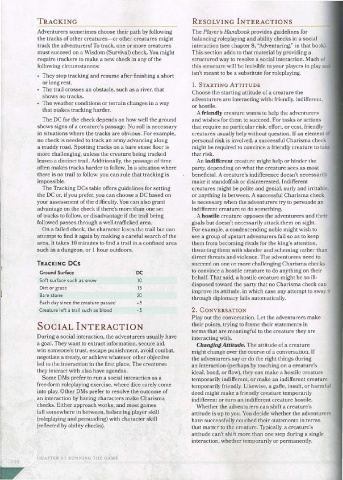
               The Tracking DCs table offers guidelines for setting   creatures might be polite and genial, surly and irritable
              the DC or, if you prefer, you can choose a DC based on   or anything in between. A successful Charisma check
             your assessment of the difficulty. You can also grant   is necessary when the adventurers try to persuade an
              advantage on the check if there's more than one set   indifferent creature to do something.
              of tracks to follow, or disadvantage if the trail being   A hostile creature opposes the adventurers and their
              followed passes through a well-trafficked area.   goals but doesn't necessarily attack them on sight.
               On a failed check, the character loses the trail but can   For example, a condescending noble might wish to
              attempt to find it again by making a careful search of the   see a group of upstart adventurers fail so as to keep
              area. It takes 10 minutes to find a trail in a confined area   them from becoming rivals for the king's attention,
             such as a dungeon, or 1 hour outdoors.            thwarting them with slander and scheming rather than
                                                               direct threats and violence. The adventurers need to
             TRACKING  DCs                                     succeed on one or more challenging Charisma checks
              Ground Surface                 DC                to convince a hostile creature to do anything on their
                                                               behalf. That said, a hostile creature might be so ill-
              Soft surface such as snow       10
                                                               disposed toward the party that no Charisma check can
              Dirt or grass                   15
                                                               improve its attitude, in which case any attempt to sway i·
              Bare stone                      20
                                                               through diplomacy fails automatically.
              Each day since the creature passed   +5
              Creature left a trail such as  blood   -5        2.  CONVERSATION
                                                               Play out the conversation. Let the adventurers make
              SOCIAL INTERACTION                               their points, trying to frame their statements in
                                                               terms that are meaningful to the creature they are
             During a social interaction, the adventurers usually have   interacting with.
             a goal. They want to extract information, secure aid,   Changing Attitude. The attitude of a creature
             win someone's trust, escape punishment, avoid combat,   might change over the course of a conversation. If
             negotiate a treaty, or achieve whatever other objective   the adventurers say or do the right things during
             led to the interaction in the first place. The creatures   an interaction (perhaps by touching on a creature's
             they interact with also have agendas.             ideal, bond, or flaw), they can make a hostile creature
               Some DMs prefer to run a social interaction as a   temporarily indifferent, or make an indifferent creature
             free-form roleplaying exercise, where dice rarely come   temporarily friendly. Likewise, a gaffe, insult, or harmful
             into play. Other DMs prefer to resolve the outcome of   deed might make a friendly creature temporarily
             an interaction by having characters make Charisma   indifferent or turn an indifferent creature hostile.
             checks. Either approach works, and most games       Whether the adventurers can shift a creature's
             fall somewhere in between, balancing player skill   attitude is up to you. You decide whether the adventurer
             (roleplaying and persuading) with character skill   have successfully couched their statements in terms
             (reflected by ability checks).                    that matter to the creature. Typically, a creature's
                                                               attitude can't shift more than one step during a single
                                                               interaction, whether temporarily or permanently.


             CHAPTER  8  I RUNNING THE GAME

