


Page 48 - The Golf Guide, Fall 2017
P. 48
Golf Destination

Keswick Hall & Golf Club ~ Full Cry Offers Plenty

                                          Nick Ciattei

Any return visit to Keswick Hall & Golf Club near Charlottesville is always greeted
by this writer with open arms. In this instance, I was finally able to tee it up on the
Pete Dye designed Full Cry Golf Course. Since its opening in late 2014, Full Cry has
received plenty of rave reviews, and I am ready to add another glowing assessment
to that list.

The name Full Cry comes from the howl
of the hounds prevalent in this part of
Central Virginia during a hunt. While
my game sometimes warrants such
bellows, only exclamations of joy were
barked on this golf journey. I played
the original Arnold Palmer design at
Keswick back in 2010, so I could barely
wait to see what Mr. Dye had up his
sleeve at Full Cry. The course is built
right on top of the previous layout, but
further comparison ends there. The name “Dye” normally conjures up images of
railroad ties, bulk-headed water hazards, and pot bunkers. A few of those subsist
here, and the lakes and ponds are handsomely graced by stone. But with amenable
challenges, you end up with an ideal resort course that will not beat you up. Every
level of player is considered with five sets of tees ranging from 4800 to over 7100
yards from the tips. The more than generous fairways motivated me to pull out my
driver without hesitation!

                             The front nine on Full Cry opens with a
                             par 4 with a creek down the right side
                             being your main concern. This green,
                             like many, has a generous opening at
                             the front. The par 5 second plays uphill
                             and a large tree protects the left side of
                             the putting surface. Holes four through
                             seven are recognized as the hardest
                             stretch on the golf course. A couple of
                             solid par 3s sandwich the two tough
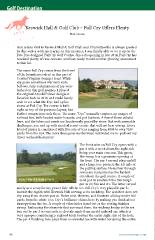
Hole 1 Par 4 & Hole 2 Par 5

                             par 4s on five and six. The latter served
nicely as a setup for my power fade off the tee. Full Cry’s very playable par 5s
include the eighth with Keswick Hall serving as its backdrop. The architect does not
shy away from shorter par 4s. Holes nine, thirteen, and fourteen all play under 300
yards from the white tees. Dye’s brilliance shines here by making you think about
strategy from the tee. A couple of other holes stand out as the routing finishes
strong. Embracing the elements that surround them, the walking bridge to the tee
box on the par 5 seventeenth is cleverly made from an old railroad car, which is
very apropos considering a railroad track borders the entire right side of the hole.
The par 4 finishing hole plays from an elevated tee with water bordering the entire

46	 GOLFGUIDEINC.COM

