


Page 100 - Module DMV20173
P. 100
5. 0    JOINING PROCESSES


                     Example 5.2

                     Describe the process characteristics of resistance welding.

                     Solution:

                     Process characteristics:
                        1.  Requires no filler metal or fluxes.

                        2.  Can achieve high speed production.

                        3.  Is easily automated.

                        4.  Does not require skilled operators.

                        5.  Is used primarily on sheet metal.

                        6.  Uses non-consumable, low resistance, copper allow electrodes.


                     5.4  BRAZING


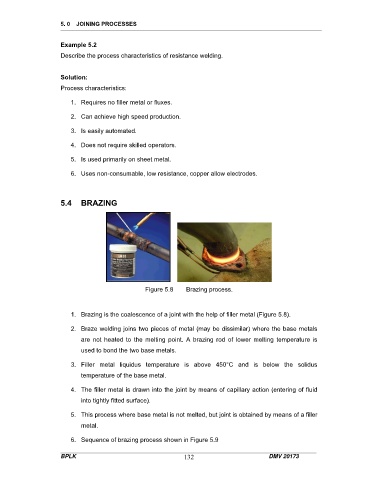
                                                 Figure 5.8    Brazing process.


                        1.  Brazing is the coalescence of a joint with the help of filler metal (Figure 5.8).

                        2.  Braze welding joins two pieces of metal (may be dissimilar) where the base metals
                            are  not  heated  to  the melting  point.  A  brazing  rod  of  lower  melting  temperature  is

                            used to bond the two base metals.
                        3.  Filler  metal  liquidus  temperature  is  above  450°C  and  is  below  the  solidus

                            temperature of the base metal.

                        4.  The filler metal is drawn into the joint by means of capillary action (entering of fluid
                            into tightly fitted surface).

                        5.  This process where base metal is not melted, but joint is obtained by means of a filler
                            metal.

                        6.  Sequence of brazing process shown in Figure 5.9


                     BPLK                                       132                        DMV 20173

