


Page 24 - April_2018_Digital_Edition
P. 24
Features

                              Editor’s Spotlight

                 his month the editor’s     The reserve is an
                 spotlight falls on Staveley   example of a successfully restored
                 Nature Reserve (SNR), a    quarry. Formerly known as Staveley
                 sup
         T erb wetland site lying           Carrs, in the 18th century, the site
         close to the River Tutt that holds year  was part of an extensive natural
         round interest for visitors with   wetland known for its rare marsh
         regular sightings of otters and several  plants. The wetlands were drained
         orchid species among the highlights.  for agriculture in the 19th century
                                            and quarried for building materials in
                                            the 20th century. Quarrying for sand,
          Getting there
          By car, access the main car park   gravel and clay stopped in the 1970s.
          on the Staveley to Minskip road.
          Please do not park along the road.   The gravel pits were flooded and the
          Disabled access is via radar key   site allowed to regenerate naturally
          from the track next to the church   for many years. Its complex ecology
          on Main Street.                   is now similar to the original
                                            wetlands. In 2002, the Yorkshire
          On foot, access the reserve on the   Wildlife Trust (YWT) bought the
          footpath by Carr Top Farm or the   reserve, extending it in 2012, and
          footpath by the side of the Royal   local volunteers now work with the
          Oak pub.
                                            Trust on a continued programme of
                                            restoration and maintenance.

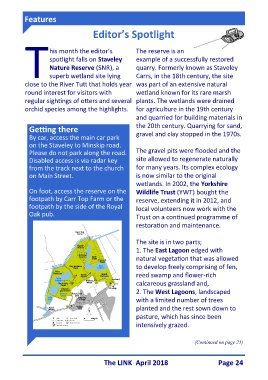
                                            The site is in two parts;
                                            1. The East Lagoon edged with
                                            natural vegetation that was allowed
                                            to develop freely comprising of fen,
                                            reed swamp and flower-rich
                                            calcareous grassland and,
                                            2. The West Lagoons, landscaped
                                            with a limited number of trees
                                            planted and the rest sown down to
                                            pasture, which has since been
                                            intensively grazed.

                                                              (Continued on page 25)


                                  The LINK   April 2018               Page 24

