


Page 30 - Template Tesis UTM v2.0
P. 30
Commercial Aerospace
                                                                                Civil Engineering

                                                                               Automotive
                             Value (Million)                                    Marine
                                                                                Wind Energy


                                                                                Sporting Goods
                                                                                Space/Satellite

                                                                                General Aviation
                                                                               Military/ Defence

                                                                                Others
                                                  Year

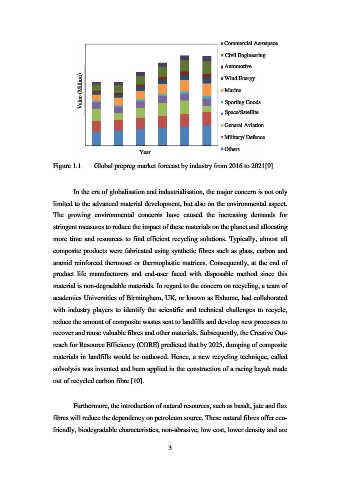
                   Figure 1.1     Global prepreg market forecast by industry from 2016 to 2021[9]


                           In the era of globalisation and industrialisation, the major concern is not only

                   limited to the advanced material development, but also on the environmental aspect.
                   The  growing  environmental  concerns  have  caused  the  increasing  demands  for

                   stringent measures to reduce the impact of these materials on the planet and allocating

                   more time and resources to find efficient recycling solutions. Typically, almost all
                   composite products were fabricated using synthetic fibres such as glass, carbon and

                   aramid reinforced thermoset or thermoplastic matrices. Consequently, at the end of
                   product  life  manufacturers  and  end-user  faced  with  disposable  method  since  this

                   material is non-degradable materials. In regard to the concern on recycling, a team of
                   academics Universities of Birmingham, UK, or known as Exhume, had collaborated

                   with industry players to identify the scientific and technical challenges  to recycle,

                   reduce the amount of composite wastes sent to landfills and develop new processes to
                   recover and reuse valuable fibres and other materials. Subsequently, the Creative Out-

                   reach for Resource Efficiency (CORE) predicted that by 2025, dumping of composite
                   materials in landfills would be outlawed. Hence, a new recycling technique, called

                   solvolysis was invented and been applied in the construction of a racing kayak made
                   out of recycled carbon fibre [10].


                           Furthermore, the introduction of natural resources, such as basalt, jute and flax

                   fibres will reduce the dependency on petroleum source. These natural fibres offer eco-
                   friendly, biodegradable characteristics, non-abrasive, low cost, lower density and are


                                                            3

