


Page 69 - Template Tesis UTM v2.0
P. 69
Untreated     Treated                   Untreated      Treated


                       Tensile strength (MPa)                 Tensile modulus (GPa)


                                  Hybrid formulation                       Hybrid formulation


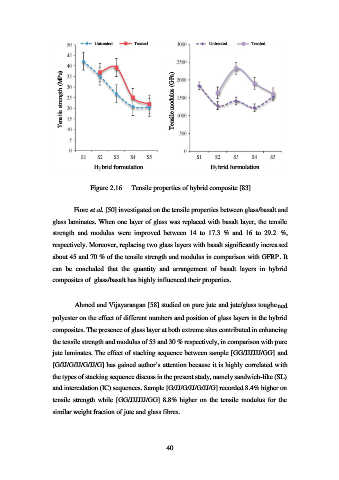
                                Figure 2.16    Tensile properties of hybrid composite [83]


                           Fiore et al. [50] investigated on the tensile properties between glass/basalt and

                   glass laminates. When one layer of glass was replaced with basalt layer, the tensile
                   strength  and  modulus  were  improved  between  14  to  17.3  %  and  16  to  29.2  %,

                   respectively. Moreover, replacing two glass layers with basalt significantly increased
                   about 45 and 70 % of the tensile strength and modulus in comparison with GFRP. It

                   can  be  concluded  that  the  quantity  and  arrangement  of  basalt  layers  in  hybrid

                   composites of  glass/basalt has highly influenced their properties.


                            Ahmed and Vijayarangan [58] studied on pure jute and jute/glass toughened

                   polyester on the effect of different numbers and position of glass layers in the hybrid
                   composites. The presence of glass layer at both extreme sites contributed in enhancing

                   the tensile strength and modulus of 53 and 30 % respectively, in comparison with pure
                   jute laminates. The effect of stacking sequence between sample [GG/JJJJJJ/GG] and

                   [G/JJ/G/JJ/G/JJ/G] has gained author’s attention because it is highly correlated with

                   the types of stacking sequence discuss in the present study, namely sandwich-like (SL)
                   and intercalation (IC) sequences. Sample [G/JJ/G/JJ/G/JJ/G] recorded 8.4% higher on

                   tensile strength  while  [GG/JJJJJJ/GG] 8.8%  higher on the tensile  modulus  for the

                   similar weight fraction of jute and glass fibres.


                                                           40

