


Page 78 - Template Tesis UTM v2.0
P. 78
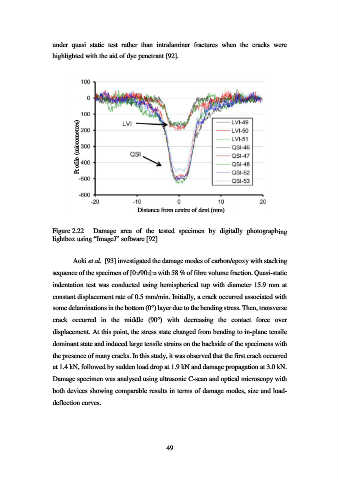
under  quasi  static  test  rather  than  intralaminar  fractures  when  the  cracks  were

                   highlighted with the aid of dye penetrant [92].


                            Profile (micrometres)


                                                 Distance from centre of dent (mm)


                   Figure 2.22    Damage  area  of  the  tested  specimen  by  digitally  photographing
                   lightbox using “ImageJ” software [92]


                           Aoki et al.  [93] investigated the damage modes of carbon/epoxy with stacking

                   sequence of the specimen of [02/902]2S with 58 % of fibre volume fraction. Quasi-static

                   indentation test was conducted using hemispherical tup with diameter 15.9 mm at
                   constant displacement rate of 0.5 mm/min. Initially, a crack occurred associated with

                   some delaminations in the bottom (0°) layer due to the bending stress. Then, transverse
                   crack  occurred  in  the  middle  (90°)  with  decreasing  the  contact  force  over

                   displacement. At this point, the stress state changed from bending to in-plane tensile
                   dominant state and induced large tensile strains on the backside of the specimens with

                   the presence of many cracks. In this study, it was observed that the first crack occurred

                   at 1.4 kN, followed by sudden load drop at 1.9 kN and damage propagation at 3.0 kN.
                   Damage specimen was analysed using ultrasonic C-scan and optical microscopy with

                   both devices showing comparable results in terms of damage modes, size and load-
                   deflection curves.


                                                           49

