


Page 50 - Spotlight A+ Form 4 & 5 Chemistry KSSM
P. 50
(iii)  Sodium chloride, NaCl cannot conduct electricity in solid state but it can conduct electricity in
                         aqueous state. Explain why.                                          [2 marks]
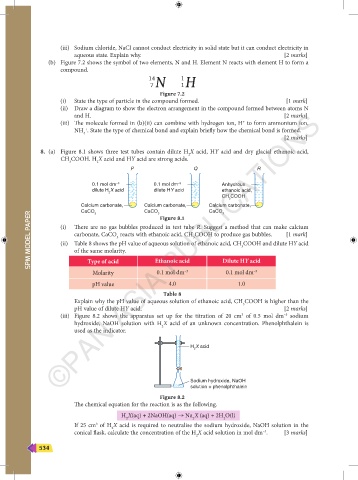
                 (b)  Figure 7.2 shows the symbol of two elements, N and H. Element N reacts with element H to form a
                     compound.
                                                  14 N      1 H
                                                  7         1
                                                      Figure 7.2
                     (i)   State the type of particle in the compound formed.                  [1 mark]
                     (ii)  Draw a diagram to show the electron arrangement in the compound formed between atoms N
                         and H.                                                               [2 marks]
                     (iii)  The molecule formed in (b)(ii) can combine with hydrogen ion, H  to form ammonium ion,
                                                                                 +
                         NH . State the type of chemical bond and explain briefly how the chemical bond is formed.
                             +
                            4
                                                                                              [2 marks]
               8.  (a)  Figure  8.1 shows three test tubes contain dilute H X acid, HY acid and dry glacial ethanoic acid,
                                                               2
                     CH COOH. H X acid and HY acid are strong acids.
                        3        2
                                            P                   Q                    R

                               0.1 mol dm          0.1 mol dm             Anhydrous
                                       –3
                                                           –3
                               dilute H X acid     dilute HY acid         ethanoic acid,
                                     2
                                                                          CH COOH
                                                                            3
                            Calcium carbonate,  Calcium carbonate,    Calcium carbonate,
                                                                      CaCO
                                                CaCO
                            CaCO
           SPM MODEL PAPER   ©PAN ASIA PUBLICATIONS
                                                                          3
                                3
                                                     3
                                                      Figure 8.1
                         There are no gas bubbles produced in test tube R. Suggest a method that can make calcium
                     (i)
                         carbonate, CaCO  reacts with ethanoic acid, CH COOH to produce gas bubbles.
                                                                                               [1 mark]
                                                                3
                                       3
                     (ii)  Table 8 shows the pH value of aqueous solution of ethanoic acid, CH COOH and dilute HY acid
                                                                                3
                         of the same molarity.
                              Type of acid
                                                    0.1 mol dm
                               Molarity             Ethanoic acid         Dilute HY acid
                                                                                    –3
                                                                           0.1 mol dm
                                                              –3
                               pH value                 4.0                    1.0
                                                       Table 8
                         Explain why the pH value of aqueous solution of ethanoic acid, CH COOH is higher than the
                                                                                 3
                         pH value of dilute HY acid.                                          [2 marks]
                     (iii)  Figure 8.2 shows the apparatus set up for the titration of 20 cm  of 0.5 mol dm  sodium
                                                                                              –3
                                                                                3
                         hydroxide, NaOH solution with H X acid of an unknown concentration. Phenolphthalein is
                                                      2
                         used as the indicator.
                                                               H X acid
                                                                 2
                                                               Sodium hydroxide, NaOH
                                                               solution + phenolphthalein
                                                      Figure 8.2
                         The chemical equation for the reaction is as the following.
                                         H X(aq) + 2NaOH(aq) → Na X (aq) + 2H O(l)
                                          2                     2         2
                                3
                         If 25 cm  of H X acid is required to neutralise the sodium hydroxide, NaOH solution in the
                                      2
                         conical flask, calculate the concentration of the H X acid solution in mol dm .   [3 marks]
                                                                                       –3
                                                                 2
              534

