


Page 47 - Spotlight A+ Form 4 & 5 Chemistry KSSM
P. 47
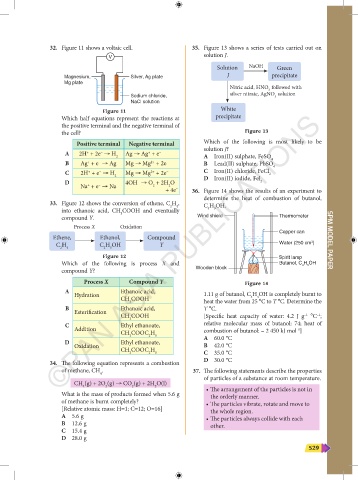
32.  Figure 11 shows a voltaic cell.           35.  Figure 13 shows a series of tests carried out on
                                                                    solution J.
                                     V
                                                                        Solution   NaOH     Green
                                                                            J             precipitate
                      Magnesium,            Silver, Ag plate
                      Mg plate
                                                                            Nitric acid, HNO  followed with
                                                                                         3
                                                                            silver nitrate, AgNO  solution
                                            Sodium chloride,                               3
                                            NaCl solution
                                   Figure 11                             White
                    ©PAN ASIA PUBLICATIONS
                     Which  half equations represent the reactions at   precipitate
                     the positive terminal and the negative terminal of
                     the cell?                                                   Figure 13

                          Positive terminal  Negative terminal      Which  of the following is most likely to be
                             +
                      A    2H  + 2e  → H  Ag → Ag  + e −            solution J?
                                  −
                                                  +
                                       2                            A  Iron(II) sulphate, FeSO 4
                      B    Ag  + e  → Ag  Mg → Mg  + 2e −           B  Lead(II) sulphate, PbSO 4
                                                  2+
                                 −
                              +
                                                  2+
                                  −
                              +
                      C    2H  + e  → H 2  Mg → Mg  + 2e −          C  Iron(II) chloride, FeCl 2
                      D                   4OH  → O  + 2H O          D  Iron(II) iodide, Fel 2
                                              −
                           Na  + e  → Na           2    2
                              +
                                 −
                                                        + 4e −   36.  Figure 14 shows the results of an experiment to
                                                                    determine the heat of combustion of butanol,
                  33.  Figure 12 shows the conversion of ethene, C H ,   C H OH.
                                                         2
                                                           4
                     into ethanoic acid, CH COOH and eventually      4  9
                                         3
                     compound Y.                                  Wind shield                Thermometer
                         Process X      Oxidation
                                                                                             Copper can
                  Ethene,         Ethanol,       Compound                                                   SPM MODEL PAPER
                                                                                                       3
                   C H            C H OH             Y                                       Water (250 cm )
                     2  4          2  5
                                   Figure 12                                                Spirit lamp
                     Which  of the following is process  X and                               Butanol, C H OH
                                                                                                    4
                                                                                                      9
                     compound Y?                                 Wooden block
                             Process X     Compound Y                            Figure 14
                      A                  Ethanoic acid,
                         Hydration                                  1.11 g of butanol, C H OH is completely burnt to
                                                                                     4
                                                                                   4
                                         CH COOH                    heat the water from 25 ºC to T ºC. Determine the
                                           3
                      B                  Ethanoic acid,             T ºC.
                         Esterification
                                         CH COOH                     [Specific  heat capacity of water: 4.2 J g   ºC ;
                                                                                                     –1
                                                                                                         –1
                                           3
                      C                  Ethyl ethanoate,           relative  molecular  mass  of  butanol:  74;  heat  of
                         Addition                                   combustion of butanol: – 2 450 kJ mol ]
                                                                                                  –1
                                         CH COOC H
                                           3      2  5              A  60.0 °C
                      D                  Ethyl ethanoate,
                         Oxidation                                  B  42.0 °C
                                         CH COOC H
                                           3      2  5              C  35.0 °C
                  34.  The following equation represents a combustion   D  30.0 °C
                     of methane, CH .                            37.  The following statements describe the properties
                                  4
                                                                    of particles of a substance at room temperature.
                         CH (g) + 2O (g) → CO (g) + 2H O(l)
                                                    2
                                            2
                            4
                                    2
                     What is the mass of products formed when 5.6 g   • The arrangement of the particles is not in
                                                                      the orderly manner.
                     of methane is burnt completely?                 • The particles vibrate, rotate and move to
                      [Relative atomic mass: H=1; C=12; O=16]         the whole region.
                     A  5.6 g                                        • The particles always collide with each
                     B   12.6 g                                       other.
                     C   15.4 g
                     D   28.0 g
                                                                                                      529

