


Page 25 - Spotlight A+ Physics Form 4.5
P. 25
Form
           5         Physics   Chapter 7 Quantum Physics


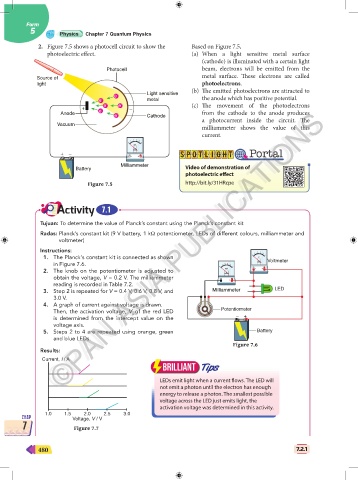
              2.  Figure 7.5 shows a photocell circuit to show the   Based on Figure 7.5,
                photoelectric effect.                          (a)  When a light sensitive metal surface
                                                                   (cathode) is illuminated with a certain light
                                    Photocell                      beam,  electrons  will  be emitted from  the
                                                                   metal surface. These electrons are called
             Source of
             light                                                 photoelectrons.
                                                               (b)  The emitted photoelectrons are attracted to
                                                 Light sensitive
                                      e -                          the anode which has positive potential.
                                 e -             metal
                                   e -  e -                    (c)  The movement of the photoelectrons
                             +    -         _
                     ©PAN ASIA PUBLICATIONS
                     Anode       e                                 from the cathode to the anode produces
                    ©PAN ASIA PUBLICATIONS
                                      e -        Cathode
                                                                   a  photocurrent  inside  the  circuit.  The
                    Vacuum
                                                                   milliammeter shows the value of this
                                                                   current.
                                            2  3
                                           1  4
                                           0   5
                                            mA
                     +  _
                                            −  +
                                        Milliammeter         Video of demonstration of
                          Battery
                                                             photoelectric effect
                              Figure 7.5                     http://bit.ly/31HRcpe
                   Activity       7.1

              Tujuan: To determine the value of Planck’s constant using the Planck’s constant kit
              Radas:  Planck’s constant kit (9 V battery, 1 kΩ potentiometer, LEDs of different colours, milliammeter and
                    voltmeter)
              Instructions:                                                          2  3
                                                                                    1 0  4  5
                1.  The Planck's constant kit is connected as shown                  V
                                                                                        Voltmeter
                  in Figure 7.6.                                         1  2  3  4
                                                                        0    5
                2.  The knob on the potentiometer is adjusted to          mA        −  +
                  obtain the voltage, V = 0.2 V. The milliammeter
                                                                         −  +
                  reading is recorded in Table 7.2.
                3.  Step 2 is repeated for V = 0.4 V, 0.6 V, 0.8 V, and   Milliammeter    LED
                  3.0 V.
                4.  A graph of current against voltage is drawn.
                  Then, the activation voltage, V of the red LED         Potentiometer
                                            a                                 –  +
                  is  determined  from  the  intercept  value  on  the
                  voltage axis.
                5.  Steps 2 to 4 are repeated using orange, green                    Battery
                  and blue LEDs.
                                                                             Figure 7.6
              Results:
               Current, I / A


                                                     LEDs emit light when a current flows. The LED will
                                                     not emit a photon until the electron has enough
                                                     energy to release a photon. The smallest possible
                                                     voltage across the LED just emits light, the
                                                     activation voltage was determined in this activity.
                1.0   1.5   2.0    2.5   3.0
        CHAP             Voltage, V / V
        7                Figure 7.7


             480                                                                                 7.2.1

