


Page 17 - 1202 Question Bank Physics Form 5
P. 17
Answers
CHAPTER 1 50. A The addition of a load of 150 g causes a compression of
6 cm.
Paper 1 51. A
52. A Note the half -length spring can still only stand 10 kg (even
1. D
it is stiffer now).
2. C
53. C
3. C
4. B
5. C Paper 2
6. A
7. A Section A
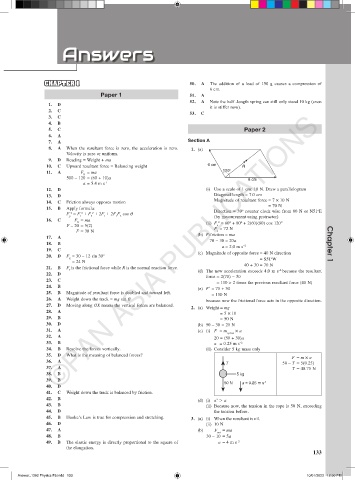
8. A When the resultant force is zero, the acceleration is zero. 1. (a)
Velocity is zero or uniform.
9. D Reading = Weight + ma
10. C Upward resultant force = Balancing weight 6 cm R
120 o
11. A F = ma
R
500 – 120 = (60 + 10)a 8 cm
a = 5.4 m s –1
12. D (i) Use a scale of 1 cm: 10 N. Draw a parallelogram
13. D Diagonal length = 7.0 cm
Magnitude of resultant force = 7 µ 10 N
14. C Friction always opposes motion
15. B Apply formula: o = 70 N o
F = F + F + 2F + 2F F cos q Direction = 39 counter clock wise from 80 N or N51 E
2
2
2
p 1 2 1 1 2 (by measurement using protractor)
16. C F = ma
R (ii) F = 60 + 80 + 2(60)(80) cos 120°
2
2
2
F – 20 = 5(2) p
F = 30 N F = 72 N
p
(b) F-friction = ma
17. A
70 − 30 = 20a
18. B a = 2.0 m s –2 Chapter 1
C
19. D©PAN ASIA PUBLICATIONS
(c) Magnitude of opposite force = 40 N direction
20. D F = 30 – 12 sin 30°
o
g = S51 W
= 24 N
40 + 30 = 70 N
21. B F is the frictional force while R is the normal reaction force.
–2
f (d) The new acceleration exceeds 4.0 m s because the resultant
22. D force = 2(70) − 30
23. C
= 110 > 2 times the previous resultant force (40 N)
24. B
(e) Fʹ = 70 + 30
25. B Magnitude of resultant force is doubled and toward left. = 100 N
26. A Weight down the track = mg sin q because now the frictional force acts in the opposite direction.
27. D Moving along OX means the vertical forces are balanced.
2. (a) Weight = mg
28. A = 5 µ 10
29. B = 50 N
30. D (b) 50 – 30 = 20 N
31. A (c) (i) F = m µ a
system
32. A 20 = (50 + 30)a
33. B a = 0.25 m s –2
34. B Resolve the forces vertically. (ii) Consider 5 kg mass only
35. D What is the meaning of balanced forces? F = m µ a
36. A 50 – T = 5(0.25)
T
37. A T = 48.75 N
38. B 5 kg
39. B 50 N a = 0.25 m s -2
40.
41. C Weight down the track is balanced by friction.
42. B (d) (i) a’ a
43. B (ii) Because now, the tension in the rope is 50 N, exceeding
44. D the tension before.
45. B Hooke’s Law is true for compression and stretching. 3. (a) (i) When the resultant is nil.
46. D (ii) 10 N
47. A (b) F = ma
net
48. B 30 – 10 = 5a
49. B The elastic energy is directly proportional to the square of a = 4 m s –2
the elongation.
133
Answer_1202 Physics F5.indd 133 10/01/2022 12:50 PM

