


Page 19 - 1202 Question Bank Physics Form 5
P. 19
(e)  h r  = h r                                      •  Mass is equal to the product of density and volume.
                        1 1  2 2
                       900 µ 1.2 = r  µ 0.85                             •  Since the density of the oil is less, the volume to be
                                Y
                       r  = 1.27 µ 10  kg m –3                            displaced must be more. So, the wooden cube sinks more
                                3
                        Y
                    6.  (a)  (i)  Vacuum (Torricelli)                     to do so.
                       (ii)  Same
                    (b)     h r  = h r                                                Paper 3
                             1 1  2 2
                         0.760 µ 13.6 = h  µ 1
                                  2
                            h   = 10.3 m                            1.  (a)  (i)  Manipulated variable: Height of turpentine column, h
                             water                                                                            1
                    (c)       h r  = h Vr                                (ii)  Responding variable: Height of water column, h 2
                               1 1  2  2
                        0.760 µ 13 600 = h  µ 1.2
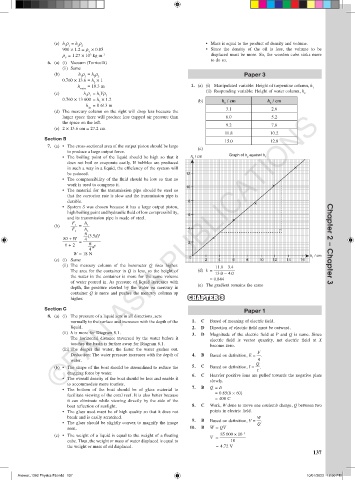
                                    2                                 (b)     h  / cm         h  / cm
                                                                                               2
                                                                               1
                               h  = 8 613 m
                                air                                             3.1             2.6
                    (d)  The mercury column on the right will drop less because the
                      ©PAN ASIA PUBLICATIONS
                       larger space there will produce less trapped air pressure than   6.0     5.2
                       the space on the left.
                                                                                9.2             7.6
                    (e)  2 µ 13.6 cm = 27.2 cm
                                                                               11.8            10.2
                 Section B
                                                                               15.0            12.8

                   7.  (a)  •  The cross-sectional area of  the output piston should be large   (c)
                        to produce a large output force.
                       •  The boiling point of the liquid should be high so  that it   h  / cm  Graph of h  against h 1
                                                                                       2
                                                                    2
                        does not boil or evaporate easily. If bubbles are produced
                        in such a way in a liquid, the efficiency of the system will
                        be reduced.                               12
                       •  The  compressibility  of  the  fluid  should  be  low  so  that  no
                        work is used to compress it.
                                                                  10
                       •  The material for the transmission pipe should be steel so
                        that the corrosion rate is slow and the transmission pipe is
                        durable.                                   8
                       •  System S was chosen because it has a large output piston,
                        high boiling point and hydraulic fluid of low compressibility,
                                                                   6
                        and its transmission pipe is made of steel.
                          F   A
                    (b)    1   =   1
                          F   A                                    4
                           2   2
                              p    2
                       80 + W  4  (3.5d)
                             =   p                                 2
                        6 + 2    d 2                                                                               Chapter 2 – Chapter 3
                                4
                           W = 18 N
                                                                   0                                         h  / cm
                                                                                                              1
                    (c)  (i)  Same                                      2    4    6    8   10   12   14   16
                       (ii)  The mercury column of the barometer  Q rises higher.   11.0 – 3.4
                          The area for the container in Q is less, so the height of   (d)  k  =   13.0 – 4.0
                          the  water  in  the  container  is  more  for  the  same  volume        = 0.844
                          of water poured in. As pressure of liquid increases with
                          depth,  the  pressure  exerted  by  the  water  on  mercury  in   (e)  The gradient remains the same
                          container Q is more and pushes the mercury column up
                          higher.                                 CHAPTER 3
                 Section C
                                                                                      Paper 1
                   8.  (a)  (i)  The pressure of a liquid acts in all directions, acts
                          normally to the surface and increases with the depth of the   1.  C  Based of meaning of electric field.
                          liquid.                                   2.  D  Direction of electric field must be outward.
                       (ii)  h is more for Diagram 8.1.             3.  D  Magnitude  of  the  electric  field  at  P and  Q is same. Since
                          The horizontal  distance  traversed  by the water before it   electric  field  is  vector  quantity,  net  electric  field  at  X
                          touches the basin is further away for Diagram 8.1.  become zero.
                       (iii) The  deeper  the  water,  the  faster  the  water  gushes out.   F
                          Deduction: The water pressure increases with the depth of   4.  B  Based on definition, E =  .
                          water.                                                          Q q
                    (b)  •  The shape of the boat should be streamlined to reduce the   5.  C  Based on definition, I =  .
                                                                                           t
                        dragging force by water.                    6.  C  Heavier positive ions are pulled towards the negative plate
                       •  The overall density of the boat should be less and enable it   slowly.
                        to accommodate more tourists.
                       •  The  bottom of the  boat  should be of glass material  to   7.  B  Q  = It
                        facilitate viewing of the coral reef. It is also better because     = 0.85(8 × 60)
                        it can eliminate  while viewing directly  by the side of the     = 408 C
                        boat reflection of sunlight.                8.  C  Work, W done to move one coulomb charge, Q between two
                       •  The glass used must be of high quality so that it does not   points in electric field.
                        break and is easily scratched.                                     W
                       •  The glass should be slightly convex to magnify the image   9.  B  Based on definition, V =  .
                                                                                           Q
                        seen.                                      10.  B  W  = QV
                    (c)  •  The weight of a liquid is equal to the weight of a floating   V  =   85 000 × 10 –3
                        cube. Thus, the weight or mass of water displaced is equal to   18
                        the weight or mass of oil displaced.                = 4.72 V
                                                                                                              137
       Answer_1202 Physics F5.indd   137                                                                    10/01/2022   12:50 PM

