


Page 118 - KSN English Final
P. 118
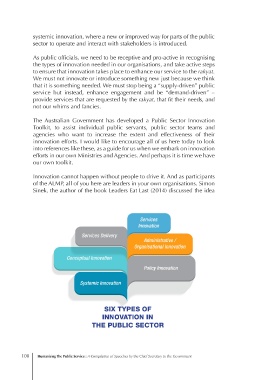
systemic innovation, where a new or improved way for parts of the public                   that real leaders put themselves last and are willing to sacrifice themselves
            sector to operate and interact with stakeholders is introduced.                            for the sake of others. They create an environment where people feel
                                                                                                       safe – what he calls the “Circle of Safety”. The principle was inspired by
            As public officials, we need to be receptive and pro-active in recognising                 leadership dynamics in the US Marine Corps, where Sinek observes that
            the types of innovation needed in our organisations, and take active steps                 higher ranked officers eat last.
            to ensure that innovation takes place to enhance our service to the rakyat.
            We must not innovate or introduce something new just because we think                      There are three key takeaways from the book that I would like to share
            that it is something needed. We must stop being a “supply-driven” public                   with all of you.
            service but instead, enhance engagement and be “demand-driven” –
            provide services that are requested by the rakyat, that fit their needs, and
            not our whims and fancies.
                                                                                                          Exceptional organisations have cultures in which the leaders provide cover from
            The Australian Government has developed a Public Sector Innovation                            above, and the people on the ground look out for each other. Real leaders minimise
            Toolkit, to  assist individual public  servants, public sector  teams and                     or take away distractions so that the team can perform well;
            agencies who want to increase the extent and effectiveness of their
            innovation efforts. I would like to encourage all of us here today to look                    Leaders of great organisations do not see people as a commodity to be manipulated
            into references like these, as a guide for us when we embark on innovation                    for the sake of merely making money. Leaders need to truly embrace the value of
            efforts in our own Ministries and Agencies. And perhaps it is time we have                    people and not merely see them as a commodity. A leader’s legacy is measured by
            our own toolkit.                                                                              the strength of the foundation they leave behind for others to continue to advance
                                                                                                          the organisation; and
            Innovation cannot happen without people to drive it. And as participants
            of the ALMP, all of you here are leaders in your own organisations. Simon                     Leaders of organisations, who rise through the ranks not because they want it, but
            Sinek, the author of the book Leaders Eat Last (2014) discussed the idea                      because the tribe keeps offering higher status out of gratitude for their willingness
                                                                                                          to sacrifice, are the true leaders worthy of our trust and loyalty. Leadership is not a
                                                                                                          race. It is not a competition with winners or losers. To lead is to serve.


                                                 Services
                                                Innovation
                                                                                                       As leaders in your own organisations, it is critical that you are committed
                             Services Delivery                                                         to helping others and “eat last”. In doing so, you create a Circle of Safety,
                                                  Administrative /                                     which is an environment of trust, respect and co-operation where teams
                                               Organisational Innovation
                                                                                                       can thrive to produce desired outcomes for the organisation.
                        Conceptual Innovation
                                                                                                       I hope that all of you will remain committed in ensuring the successful
                                                  Policy Innovation
                                                                                                       implementation of the national agenda for the betterment of the rakyat
                                                                                                       and country. More importantly for this evening, I would like to hear from
                            Systemic Innovation                                                        you your views on innovation in the public sector, and what is being done
                                                                                                       in your organisations. Are you doing enough? Is your organisation doing
                                                                                                       the right thing? And are you eating last?
                                     SIX TYPES OF                                                      With that, I would like to thank INTAN for organising the ALMP course,
                                    INNOVATION IN                                                      and I look forward to hearing your views and ideas after this.
                                THE PUBLIC SECTOR

                                                                                                       Speech at the Interaction Session with Participants of the Advanced Leadership & Management Programme.
                                                                                                       20 November 2014, National Institute of Public Administration, Bukit Kiara, Kuala Lumpur.

        108   Humanising The Public Service : A Compilation of Speeches by the Chief Secretary to the Government                                                       109

