


Page 32 - 2010-2022 hose manufactureing ability and guide
P. 32
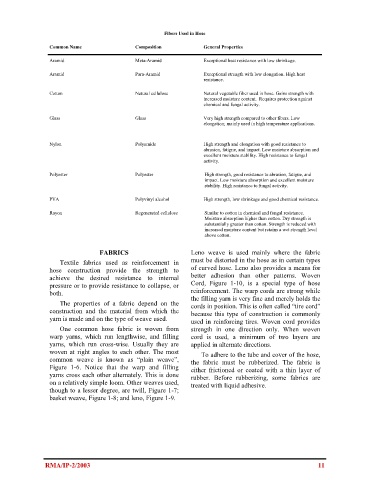
Fibers Used in Hose

                 Common Name                                             Composition                                   General Properties

                 Aramid                                                           Meta-Aramid                                   Exceptional heat resistance with low shrinkage.

                 Aramid                                                           Para-Aramid                                    Exceptional strength with low elongation. High heat

                                                                                                                                                  resistance.

                 Cotton                                                             Natural cellulose                             Natural vegetable fiber used in hose. Gains strength with

                                                                                                                                                  increased moisture content.  Requires protection against
                                                                                                                                                  chemical and fungal activity.


                 Glass                                                               Glass                                                Very high strength compared to other fibers. Low
                                                                                                                                                  elongation; mainly used in high temperature applications.


                 Nylon                                                              Polyamide                                       High strength and elongation with good resistance to
                                                                    abrasion, fatigue, and impact. Low moisture absorption and
                                                                    excellent moisture stability. High resistance to fungal
                                                                    activity.

                 Polyester                                                         Polyester                                           High strength, good resistance to abrasion, fatigue, and
                                                                     impact. Low moisture absorption and excellent moisture
                                                                     stability. High resistance to fungal activity.

                 PVA                                                               Polyvinyl alcohol                            High strength, low shrinkage and good chemical resistance.


                 Rayon                                                             Regenerated cellulose                      Similar to cotton in chemical and fungal resistance.

                                                                                                                                                   Moisture absorption higher than cotton. Dry strength is
                                                                                                                                                   substantially greater than cotton. Strength is reduced with


                                                                                                                                                   increased moisture content but retains a wet strength level
                                                                                                                                                   above cotton.

                                  FABRICS                       Leno weave is  used mainly where the  fabric
                     Textile fabrics  used as reinforcement in   must be distorted in the hose as in certain types
                 hose construction  provide the strength to     of curved hose. Leno also provides a means for
                 achieve the desired  resistance to internal    better adhesion  than  other  patterns. Woven
                 pressure or to provide resistance to collapse, or   Cord, Figure  1-10,  is a special type of hose
                 both.                                          reinforcement. The warp cords are strong while
                                                                the filling yarn is very fine and merely holds the
                     The  properties of a fabric  depend  on  the   cords in position. This is often called “tire cord”
                 construction and  the  material from which  the   because this type of construction is commonly
                 yarn is made and on the type of weave used.    used in reinforcing tires. Woven cord provides
                     One common hose fabric is woven from       strength in  one  direction only. When  woven
                 warp  yarns, which  run  lengthwise, and filling   cord is  used,  a  minimum of two  layers are
                 yarns,  which run  cross-wise. Usually they are   applied in alternate directions.
                 woven at right angles to each other.  The most     To adhere to the tube and cover of the hose,
                 common weave is  known  as  “plain  weave”,    the  fabric must  be rubberized.  The fabric is
                 Figure 1-6.  Notice  that the  warp and  filling   either frictioned or coated with a thin layer of
                 yarns cross each other alternately. This is done   rubber. Before rubberizing,  some fabrics are
                 on a relatively simple loom. Other weaves used,   treated with liquid adhesive.
                 though to a lesser degree, are twill, Figure 1-7;
                 basket weave, Figure 1-8; and leno, Figure 1-9.


                RMA/IP-2/2003                                                                             11

