


Page 172 - Towards Trustworthy Elections New Directions in Electronic Voting by Ed Gerck (auth.), David Chaum, Markus Jakobsson, Ronald L. Rivest, Peter Y. A. Ryan, Josh Benaloh, Miroslaw Kutylowski, Ben Adida ( (z-lib.org (1)
P. 172
A. Kiayias and M. Yung
                          164
                          Setup. The authorities A 1 ,...,A m execute the protocol K which results in the
                          publication in the bulletin board of the public-key pk. At the same time the
                          secret-key sk is shared amongst the authorities A 1 ,... ,A m .
                          3.2  Ballot-Casting Step
                          Each eligible voter gets authorized to the bulletin board and reads the public-key
                                                                                    2      c−1
                                                                                              }
                          pk of the system. The set of choices is defined as Choices := {1,M,M ,... ,M
                          where M is an integer with the property M> n.
                          Forming the Vector-Ballot. Each voter V i publishes a vector ballot  C 1 [i],C 2 [i],
                          C 3 [i] . If the voter wishes to select one of the predetermined choices of the
                          election she selects C 1 [i] to be an encryption of one of the values in the set Choices
                                                                                       i −1
                          while C 2 [i],C 3 [i] are encryptions of 0; in particular C 1 [i]:= E pk (M  )where
                            i ∈{1,...,c} is the personal choice of the voter, and C 2 [i]:= E pk (0),C 3 [i]:=
                          E pk (0). If the voter wishes to enter a write-in ballot she selects C 1 [i]to be an
                          encryption of 0, C 2 [i] to be an encryption of 1, and C 3 [i] to be an encryption of
                          some string string which is the voter’s write-in entry. Formally, C 1 [i]:= E pk (0),
                                         i
                          C 2 [i]:= E pk (1) and C 3 [i]:= E pk (string ). Together with her vector ballot the voter
                                                          i
                          must publish a proof of “consistent ballot encoding.” In particular V i writes a
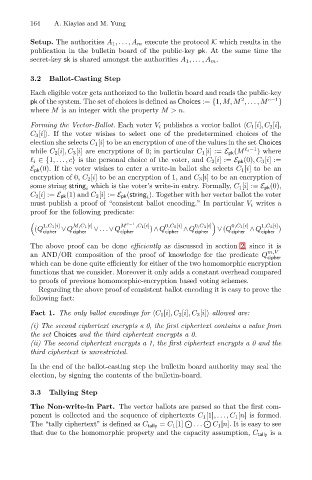
                          proof for the following predicate:
                                                    c−1
                             1,C 1 [i]  M,C 1 [i]  M   ,C 1[i]  0,C 2[i]  0,C 3[i]  0,C 1 [i]  1,C 2[i]
                                                                                              )
                           (Q     ∨Q       ∨...∨Q          )∧Q      ∧Q       ∨(Q      ∧Q
                             cipher   cipher       cipher      cipher  cipher    cipher   cipher
                          The above proof can be done efficiently as discussed in section 2, since it is
                                                                                           m,V
                          an AND/OR composition of the proof of knowledge for the predicate Q
                                                                                           cipher
                          which can be done quite efficiently for either of the two homomorphic encryption
                          functions that we consider. Moreover it only adds a constant overhead compared
                          to proofs of previous homomorphic-encryption based voting schemes.
                            Regarding the above proof of consistent ballot encoding it is easy to prove the
                          following fact:
                          Fact 1. The only ballot encodings for  C 1 [i],C 2 [i],C 3 [i]  allowed are:
                          (i) The second ciphertext encrypts a 0, the first ciphertext contains a value from
                          the set Choices and the third ciphertext encrypts a 0.
                          (ii) The second ciphertext encrypts a 1, the first ciphertext encrypts a 0 and the
                          third ciphertext is unrestricted.
                          In the end of the ballot-casting step the bulletin board authority may seal the
                          election, by signing the contents of the bulletin-board.

                          3.3  Tallying Step
                          The Non-write-in Part. The vector ballots are parsed so that the first com-
                          ponent is collected and the sequence of ciphertexts C 1 [1],... ,C 1 [n]isformed.
                          The “tally ciphertext” is defined as C tally = C 1 [1]     ...     C 1 [n]. It is easy to see
                          that due to the homomorphic property and the capacity assumption, C tally is a

