


Page 252 - Towards Trustworthy Elections New Directions in Electronic Voting by Ed Gerck (auth.), David Chaum, Markus Jakobsson, Ronald L. Rivest, Peter Y. A. Ryan, Josh Benaloh, Miroslaw Kutylowski, Ben Adida ( (z-lib.org (1)
P. 252
244


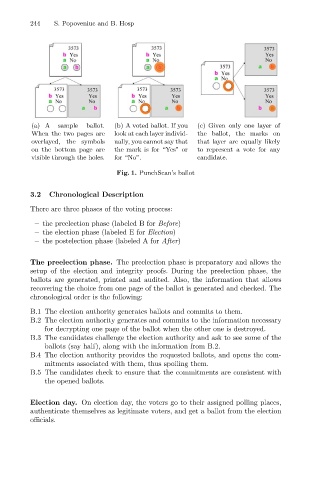
                                  sample
                          (a) A  S. Popoveniuc and B. Hosp              (c) Given only one layer of
                                                 (b) A voted ballot. If you
                                         ballot.
                          When the two pages are  look at each layer individ-  the ballot, the marks on
                          overlayed, the symbols  ually, you cannot say that  that layer are equally likely
                          on the bottom page are  the mark is for “Yes” or  to represent a vote for any
                          visible through the holes.  for “No”.         candidate.
                                                  Fig. 1. PunchScan’s ballot


                          3.2  Chronological Description
                          There are three phases of the voting process:

                           – the preelection phase (labeled B for Before)
                           – the election phase (labeled E for Election)
                           – the postelection phase (labeled A for After)

                          The preelection phase. The preelection phase is preparatory and allows the
                          setup of the election and integrity proofs. During the preelection phase, the
                          ballots are generated, printed and audited. Also, the information that allows
                          recovering the choice from one page of the ballot is generated and checked. The
                          chronological order is the following:

                          B.1 The election authority generates ballots and commits to them.
                          B.2 The election authority generates and commits to the information necessary
                              for decrypting one page of the ballot when the other one is destroyed.
                          B.3 The candidates challenge the election authority and ask to see some of the
                              ballots (say half), along with the information from B.2.
                          B.4 The election authority provides the requested ballots, and opens the com-
                              mitments associated with them, thus spoiling them.
                          B.5 The candidates check to ensure that the commitments are consistent with
                              the opened ballots.


                          Election day. On election day, the voters go to their assigned polling places,
                          authenticate themselves as legitimate voters, and get a ballot from the election
                          officials.

