


Page 255 - Towards Trustworthy Elections New Directions in Electronic Voting by Ed Gerck (auth.), David Chaum, Markus Jakobsson, Ronald L. Rivest, Peter Y. A. Ryan, Josh Benaloh, Miroslaw Kutylowski, Ben Adida ( (z-lib.org (1)
P. 255
An Introduction to PunchScan


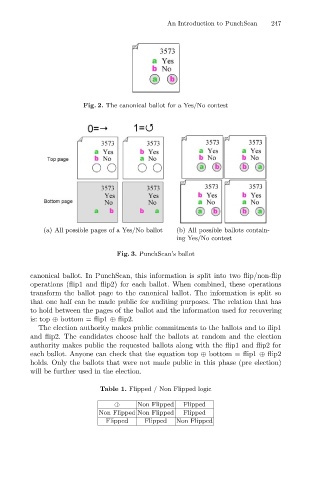
                                        Fig. 2. The canonical ballot for a Yes/No contest   247


                              (a) All possible pages of a Yes/No ballot  (b) All possible ballots contain-
                                                                  ing Yes/No contest

                                                  Fig. 3. PunchScan’s ballot


                          canonical ballot. In PunchScan, this information is split into two flip/non-flip
                          operations (flip1 and flip2) for each ballot. When combined, these operations
                          transform the ballot page to the canonical ballot. The information is split so
                          that one half can be made public for auditing purposes. The relation that has
                          to hold between the pages of the ballot and the information used for recovering
                          is: top ⊕ bottom = flip1 ⊕ flip2.
                            The election authority makes public commitments to the ballots and to flip1
                          and flip2. The candidates choose half the ballots at random and the election
                          authority makes public the requested ballots along with the flip1 and flip2 for
                          each ballot. Anyone can check that the equation top ⊕ bottom = flip1 ⊕ flip2
                          holds. Only the ballots that were not made public in this phase (pre election)
                          will be further used in the election.

                                             Table 1. Flipped / Non Flipped logic

                                                 ⊕     Non Flipped  Flipped
                                             Non Flipped Non Flipped  Flipped
                                               Flipped   Flipped  Non Flipped

