


Page 257 - Towards Trustworthy Elections New Directions in Electronic Voting by Ed Gerck (auth.), David Chaum, Markus Jakobsson, Ronald L. Rivest, Peter Y. A. Ryan, Josh Benaloh, Miroslaw Kutylowski, Ben Adida ( (z-lib.org (1)
P. 257
An Introduction to PunchScan
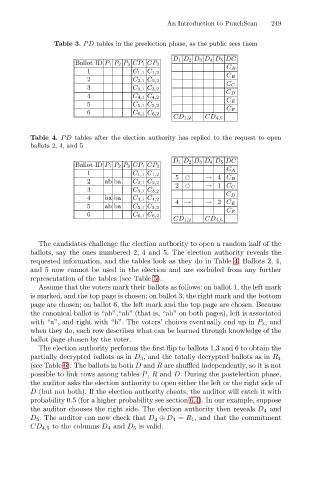
                                Table 3. PD tables in the preelection phase, as the public sees them
                                                                 D 1 D 2 D 3 D 4 D 5 DC
                                      Ballot ID P 1 P 2 P 3 CP 1 CP 2
                                                                                C A         249
                                          1           C 1,1 C 1,2
                                                                                C B
                                          2           C 2,1 C 2,2
                                                                                C C
                                          3           C 3,1 C 3,2
                                                                                C D
                                          4           C 4,1 C 4,2
                                                                                C E
                                          5           C 5,1 C 5,2
                                                                                C F
                                          6           C 6,1 C 6,2
                                                                 CD 1,2   CD 4,5
                          Table 4. PD tables after the election authority has replied to the request to open
                          ballots 2, 4, and 5
                                                                 D 1 D 2 D 3 D 4 D 5 DC
                                      Ballot ID P 1 P 2 P 3 CP 1 CP 2
                                                                                C A
                                          1           C 1,1 C 1,2  5
                                          2   ab ba   C 2,1 C 2,2  2      → 4 C B
                                          3           C 3,1 C 3,2         → 1 C C
                                                                                C D
                                          4   ba ba   C 4,1 C 4,2
                                                                  4 →     → 2 C E
                                          5   ab ba   C 5,1 C 5,2
                                                                                C F
                                          6           C 6,1 C 6,2
                                                                 CD 1,2   CD 4,5
                            The candidates challenge the election authority to open a random half of the
                          ballots, say the ones numbered 2, 4 and 5. The election authority reveals the
                          requested information, and the tables look as they do in Table 4. Ballots 2, 4,
                          and 5 now cannot be used in the election and are excluded from any further
                          representation of the tables (see Table 5).
                            Assume that the voters mark their ballots as follows: on ballot 1, the left mark
                          is marked, and the top page is chosen; on ballot 3, the right mark and the bottom
                          page are chosen; on ballot 6, the left mark and the top page are chosen. Because
                          the canonical ballot is “ab”,“ab” (that is, “ab” on both pages), left is associated
                          with “a”, and right with “b”. The voters’ choices eventually end up in P 3 ,and
                          when they do, each row describes what can be learned through knowledge of the
                          ballot page chosen by the voter.
                            The election authority performs the first flip to ballots 1,3 and 6 to obtain the
                          partially decrypted ballots as in D 3 , and the totally decrypted ballots as in R 1
                          (see Table 6). The ballots in both D and R are shuffled independently, so it is not
                          possible to link rows among tables P, R and D. During the postelection phase,
                          the auditor asks the election authority to open either the left or the right side of
                          D (but not both). If the election authority cheats, the auditor will catch it with
                          probability 0.5 (for a higher probability see section 6.4). In our example, suppose
                          the auditor chooses the right side. The election authority then reveals D 4 and
                          D 5 . The auditor can now check that D 3 ⊕ D 4 = R 1 , and that the commitment
                          CD 4,5 to the columns D 4 and D 5 is valid.

