


Page 294 - Towards Trustworthy Elections New Directions in Electronic Voting by Ed Gerck (auth.), David Chaum, Markus Jakobsson, Ronald L. Rivest, Peter Y. A. Ryan, Josh Benaloh, Miroslaw Kutylowski, Ben Adida ( (z-lib.org (1)
P. 294
R. Ara´ujo, R.F. Cust´odio, and J. van de Graaf
                          286


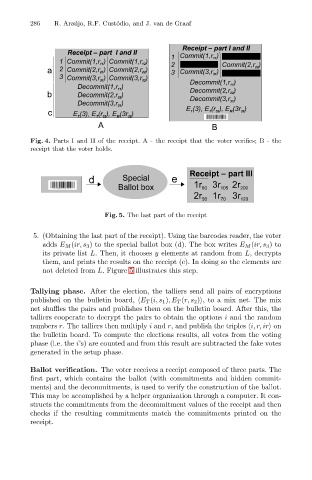
                          Fig. 4. Parts I and II of the receipt. A - the receipt that the voter verifies; B - the
                          receipt that the voter holds.


                                              Fig. 5. The last part of the receipt


                           5. (Obtaining the last part of the receipt). Using the barcodes reader, the voter
                             adds E M (ir, s 3 ) to the special ballot box (d). The box writes E M (ir, s 3 )to
                             its private list L. Then, it chooses y elements at random from L, decrypts
                             them, and prints the results on the receipt (e). In doing so the elements are
                             not deleted from L. Figure 5 illustrates this step.

                          Tallying phase. After the election, the talliers send all pairs of encryptions
                          published on the bulletin board,  E T (i, s 1 ),E T (r, s 2 ) , to a mix net. The mix
                          net shuffles the pairs and publishes them on the bulletin board. After this, the
                          talliers cooperate to decrypt the pairs to obtain the options i and the random
                          numbers r. The talliers then multiply i and r, and publish the triples  i, r, ir  on
                          the bulletin board. To compute the elections results, all votes from the voting
                          phase (i.e. the i’s) are counted and from this result are subtracted the fake votes
                          generated in the setup phase.

                          Ballot verification. The voter receives a receipt composed of three parts. The
                          first part, which contains the ballot (with commitments and hidden commit-
                          ments) and the decommitments, is used to verify the construction of the ballot.
                          This may be accomplished by a helper organization through a computer. It con-
                          structs the commitments from the decommitment values of the receipt and then
                          checks if the resulting commitments match the commitments printed on the
                          receipt.

