


Page 289 - Towards Trustworthy Elections New Directions in Electronic Voting by Ed Gerck (auth.), David Chaum, Markus Jakobsson, Ronald L. Rivest, Peter Y. A. Ryan, Josh Benaloh, Miroslaw Kutylowski, Ben Adida ( (z-lib.org (1)
P. 289
A Verifiable Voting Protocol Based on Farnel
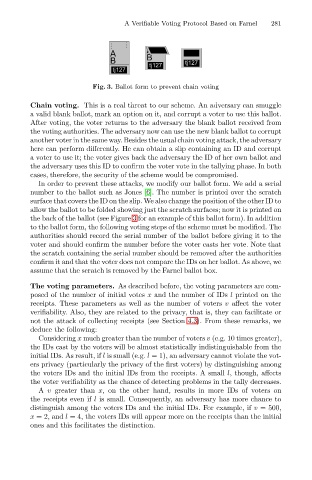
                                           Fig. 3. Ballot form to prevent chain voting      281

                          Chain voting. This is a real threat to our scheme. An adversary can smuggle
                          a valid blank ballot, mark an option on it, and corrupt a voter to use this ballot.
                          After voting, the voter returns to the adversary the blank ballot received from
                          the voting authorities. The adversary now can use the new blank ballot to corrupt
                          another voter in the same way. Besides the usual chain voting attack, the adversary
                          here can perform differently. He can obtain a slip containing an ID and corrupt
                          a voter to use it; the voter gives back the adversary the ID of her own ballot and
                          the adversary uses this ID to confirm the voter vote in the tallying phase. In both
                          cases, therefore, the security of the scheme would be compromised.
                            In order to prevent these attacks, we modify our ballot form. We add a serial
                          number to the ballot such as Jones [6]. The number is printed over the scratch
                          surface that covers the ID on the slip. We also change the position of the other ID to
                          allow the ballot to be folded showing just the scratch surfaces; now it is printed on
                          the back of the ballot (see Figure 3 for an example of this ballot form). In addition
                          to the ballot form, the following voting steps of the scheme must be modified. The
                          authorities should record the serial number of the ballot before giving it to the
                          voter and should confirm the number before the voter casts her vote. Note that
                          the scratch containing the serial number should be removed after the authorities
                          confirm it and that the voter does not compare the IDs on her ballot. As above, we
                          assume that the scratch is removed by the Farnel ballot box.
                          The voting parameters. As described before, the voting parameters are com-
                          posed of the number of initial votes x and the number of IDs l printed on the
                          receipts. These parameters as well as the number of voters v affect the voter
                          verifiability. Also, they are related to the privacy, that is, they can facilitate or
                          not the attack of collecting receipts (see Section 4.3). From these remarks, we
                          deduce the following:
                            Considering x much greater than the number of voters v (e.g. 10 times greater),
                          the IDs cast by the voters will be almost statistically indistinguishable from the
                          initial IDs. As result, if l is small (e.g. l = 1), an adversary cannot violate the vot-
                          ers privacy (particularly the privacy of the first voters) by distinguishing among
                          the voters IDs and the initial IDs from the receipts. A small l, though, affects
                          the voter verifiability as the chance of detecting problems in the tally decreases.
                            A v greater than x, on the other hand, results in more IDs of voters on
                          the receipts even if l is small. Consequently, an adversary has more chance to
                          distinguish among the voters IDs and the initial IDs. For example, if v = 500,
                          x =2, and l = 4, the voters IDs will appear more on the receipts than the initial
                          ones and this facilitates the distinction.

