


Page 290 - Towards Trustworthy Elections New Directions in Electronic Voting by Ed Gerck (auth.), David Chaum, Markus Jakobsson, Ronald L. Rivest, Peter Y. A. Ryan, Josh Benaloh, Miroslaw Kutylowski, Ben Adida ( (z-lib.org (1)
P. 290
R. Ara´ujo, R.F. Cust´odio, and J. van de Graaf
                          282
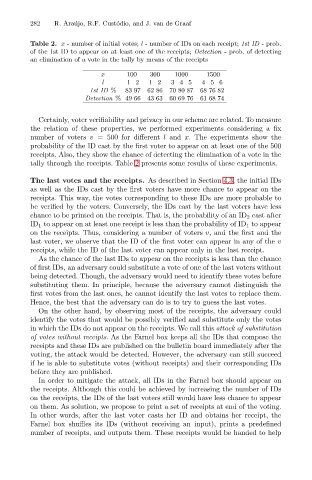
                          Table 2. x - number of initial votes; l -number of IDs on each receipt; 1st ID -prob.
                          of the 1st ID to appear on at least one of the receipts; Detection - prob. of detecting
                          an elimination of a vote in the tally by means of the receipts
                                             x      100    300    1000    1500
                                              l      12    12    34 5    456
                                          1st ID %  8397  6286  70 8087  6876 82
                                         Detection % 4966  4363  60 6976  6168 74
                            Certainly, voter verifiability and privacy in our scheme are related. To measure
                          the relation of these properties, we performed experiments considering a fix
                          number of voters v = 500 for different l and x. The experiments show the
                          probability of the ID cast by the first voter to appear on at least one of the 500
                          receipts. Also, they show the chance of detecting the elimination of a vote in the
                          tally through the receipts. Table 2 presents some results of these experiments.

                          The last votes and the receipts. As described in Section 4.3, the initial IDs
                          as well as the IDs cast by the first voters have more chance to appear on the
                          receipts. This way, the votes corresponding to these IDs are more probable to
                          be verified by the voters. Conversely, the IDs cast by the last voters have less
                          chance to be printed on the receipts. That is, the probability of an ID 2 cast after
                          ID 1 to appear on at least one receipt is less than the probability of ID 1 to appear
                          on the receipts. Thus, considering a number of voters v, and the first and the
                          last voter, we observe that the ID of the first voter can appear in any of the v
                          receipts, while the ID of the last voter can appear only in the last receipt.
                            As the chance of the last IDs to appear on the receipts is less than the chance
                          of first IDs, an adversary could substitute a vote of one of the last voters without
                          being detected. Though, the adversary would need to identify these votes before
                          substituting them. In principle, because the adversary cannot distinguish the
                          first votes from the last ones, he cannot identify the last votes to replace them.
                          Hence, the best that the adversary can do is to try to guess the last votes.
                            On the other hand, by observing most of the receipts, the adversary could
                          identify the votes that would be possibly verified and substitute only the votes

                          in which the IDs do not appear on the receipts. We call this attack of substitution
                          of votes without receipts. As the Farnel box keeps all the IDs that compose the
                          receipts and these IDs are published on the bulletin board immediately after the
                          voting, the attack would be detected. However, the adversary can still succeed
                          if he is able to substitute votes (without receipts) and their corresponding IDs
                          before they are published.
                            In order to mitigate the attack, all IDs in the Farnel box should appear on
                          the receipts. Although this could be achieved by increasing the number of IDs
                          on the receipts, the IDs of the last voters still would have less chance to appear
                          on them. As solution, we propose to print a set of receipts at end of the voting.
                          In other words, after the last voter casts her ID and obtains her receipt, the
                          Farnel box shuffles its IDs (without receiving an input), prints a predefined
                          number of receipts, and outputs them. These receipts would be handed to help

