


Page 309 - Towards Trustworthy Elections New Directions in Electronic Voting by Ed Gerck (auth.), David Chaum, Markus Jakobsson, Ronald L. Rivest, Peter Y. A. Ryan, Josh Benaloh, Miroslaw Kutylowski, Ben Adida ( (z-lib.org (1)
P. 309
Verifying Privacy-Type Properties of Electronic Voting Protocols: A Taster
                               (* private channels *)
                               ν privCh . ν pkaCh1 . ν pkaCh2 . ν skaCh . ν skvaCh . ν skvbCh .
                               (* administrators *)
                               ( processK | processA | processA | processC | processC |     301
                               (* voters *)
                               ( let skvCh = skvaCh in let v= a in processV ) |
                               ( let skvCh = skvbCh in let v= b in processV ) )
                                                  Process 1. Main process
                            In this model we can note that bit commitment (modelled by the functions
                          commit and open) is identical to classical symmetric-key encryption. For sim-
                          plicity, we identify host names and public keys. Our model of cryptographic
                          primitives is an abstraction; for example, bit commitment gives us perfect bind-
                          ing and hiding. Digital signatures are modelled as being signatures with message
                          recovery, i.e. the signature itself contains the signed message which can be ex-
                          tracted using the checksign function. To model blind signatures we add a pair
                          of functions blind and unblind. These functions are again similar to perfect sym-
                          metric key encryption and bit commitment. However, we add a second equation
                          which permits us to extract a signature out of a blind signature, when the blind-
                          ing factor is known. Note that the equation modelling commitment cannot be
                          applied on the term open(commit(m, r 1 ), r 2 )when r 1  = r 2 .

                          Process synchronisation. As mentioned, the protocol is divided into three phases,
                          and it is important that every voter has completed the first phase before going
                          onto the second one (and then has completed the second one before continuing
                          to the third). We enforce this in our model by the keyword synch. When a pro-
                          cess encounters synch n, it waits until all the other process that could encounter
                          synch n arrive at that point too. Then all the processes are allowed to continue.
                          If there are k processes that can encounter synch n, we can implement the syn-
                          chronisation as follows. The command synch n is replaced by out(n, 0); in(n, =1)
                          where n is a globally declared private channel. Moreover we assume an additional
                          process in(n, =0);... ; in(n, =0); out(n, 1); ... ; out(n, 1)thathas k insand k outs.
                          This simple encoding is fine for our purpose since the value of k can be inferred
                          by inspecting the code; it would not work if new processes were created, e.g.
                          with “!”.
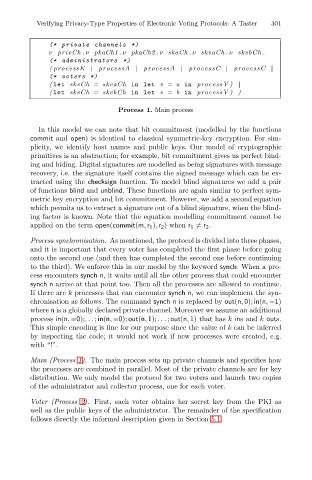
                          Main (Process 1). The main process sets up private channels and specifies how
                          the processes are combined in parallel. Most of the private channels are for key
                          distribution. We only model the protocol for two voters and launch two copies
                          of the administrator and collector process, one for each voter.
                          Voter (Process 2). First, each voter obtains her secret key from the PKI as
                          well as the public keys of the administrator. The remainder of the specification
                          follows directly the informal description given in Section 5.1.

