


Page 314 - Towards Trustworthy Elections New Directions in Electronic Voting by Ed Gerck (auth.), David Chaum, Markus Jakobsson, Ronald L. Rivest, Peter Y. A. Ryan, Josh Benaloh, Miroslaw Kutylowski, Ben Adida ( (z-lib.org (1)
P. 314
S. Delaune, S. Kremer, and M. Ryan
                          306
                           processV =
                                                          (* parameters : skvCh , v *)
                               (* her private key *)
                               in ( skvCh , skv ) .
                               (* public keys of the administrator *)
                               in ( pkaCh1 , pubka ) .
                               ν bl in der . ν r. ν td .
                               let committedvote = tdcommit ( v , r , td ) in
                               let bl i ndedcom m i ttedvote=b l i n d ( committedvote , b l i n d e r ) in
                               out ( ch1 , ( pk ( skv ) , si gn ( blindedcommittedvote , skv ) ) ) .
                               in (ch2 ,m2) .
                               let r e s u l t = checksi gn (m2, pubka ) in
                               if r e s u l t = bl i ndedcom m i ttedvote then
                               let signedcommittedvote=unbl i nd (m2, b l i n d e r ) in
                               synch 1 .
                               out ( ch3 , ( committedvote , signedcommittedvote )) .
                               out (chT , ( v , r , committedvote ))
                                                  Process 4. Voter process


                           processT =
                               synch 1 .
                               (* reception du commitment *)
                               in (chT , ( vt , rt , xt )) .
                               synch 2 .
                               if open ( xt , r t ) = vt then
                               out ( board , vt )

                                                Process 5. Timeliness process

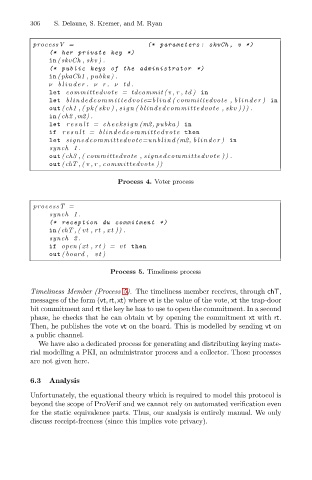
                          Timeliness Member (Process 5). The timeliness member receives, through chT,
                          messages of the form (vt, rt, xt)where vt is the value of the vote, xt the trap-door
                          bit commitment and rt the key he has to use to open the commitment. In a second
                          phase, he checks that he can obtain vt by opening the commitment xt with rt.
                          Then, he publishes the vote vt on the board. This is modelled by sending vt on
                          a public channel.
                            We have also a dedicated process for generating and distributing keying mate-
                          rial modelling a PKI, an administrator process and a collector. Those processes
                          are not given here.


                          6.3  Analysis
                          Unfortunately, the equational theory which is required to model this protocol is
                          beyond the scope of ProVerif and we cannot rely on automated verification even
                          for the static equivalence parts. Thus, our analysis is entirely manual. We only
                          discuss receipt-freeness (since this implies vote privacy).

