


Page 313 - Towards Trustworthy Elections New Directions in Electronic Voting by Ed Gerck (auth.), David Chaum, Markus Jakobsson, Ronald L. Rivest, Peter Y. A. Ryan, Josh Benaloh, Miroslaw Kutylowski, Ben Adida ( (z-lib.org (1)
P. 313
Verifying Privacy-Type Properties of Electronic Voting Protocols: A Taster
                               (* private channels *)
                               ν privCh . ν pkaCh1 . ν pkaCh2 .
                               ν skaCh . ν skvaCh . ν skvbCh . ν chT .
                               (* administrators *)                                         305
                               ( processK | processA | processA | processC | processC |
                                processT | processT |
                               (* voters *)
                               ( let skvCh=skvaCh in let v=a in processV ) |
                               ( let skvCh=skvbCh in let v=b in processV ) )
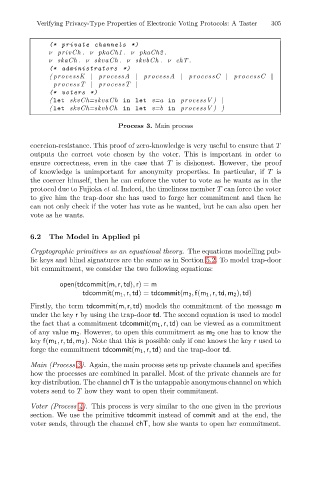
                                                  Process 3. Main process
                          coercion-resistance. This proof of zero-knowledge is very useful to ensure that T
                          outputs the correct vote chosen by the voter. This is important in order to
                          ensure correctness, even in the case that T is dishonest. However, the proof
                          of knowledge is unimportant for anonymity properties. In particular, if T is
                          the coercer himself, then he can enforce the voter to vote as he wants as in the
                          protocol due to Fujioka et al. Indeed, the timeliness member T can force the voter
                          to give him the trap-door she has used to forge her commitment and then he
                          can not only check if the voter has vote as he wanted, but he can also open her
                          vote as he wants.


                          6.2  The Model in Applied pi

                          Cryptographic primitives as an equational theory. The equations modelling pub-
                          lic keys and blind signatures are the same as in Section 5.2. To model trap-door
                          bit commitment, we consider the two following equations:

                                  open(tdcommit(m, r, td), r)= m
                                        tdcommit(m 1, r, td)= tdcommit(m 2, f(m 1 , r, td, m 2 ), td)
                          Firstly, the term tdcommit(m, r, td) models the commitment of the message m
                          under the key r by using the trap-door td. The second equation is used to model
                          thefactthatacommitment tdcommit(m 1, r, td) can be viewed as a commitment
                          of any value m 2 . However, to open this commitment as m 2 one has to know the
                          key f(m 1 , r, td, m 2 ). Note that this is possible only if one knows the key r used to
                          forge the commitment tdcommit(m 1 , r, td) and the trap-door td.

                          Main (Process 3). Again, the main process sets up private channels and specifies
                          how the processes are combined in parallel. Most of the private channels are for
                          key distribution. The channel chT is the untappable anonymous channel on which
                          voters send to T how they want to open their commitment.
                          Voter (Process 4). This process is very similar to the one given in the previous
                          section. We use the primitive tdcommit instead of commit and at the end, the
                          voter sends, through the channel chT, how she wants to open her commitment.

