


Page 383 - Towards Trustworthy Elections New Directions in Electronic Voting by Ed Gerck (auth.), David Chaum, Markus Jakobsson, Ronald L. Rivest, Peter Y. A. Ryan, Josh Benaloh, Miroslaw Kutylowski, Ben Adida ( (z-lib.org (1)
P. 383
the bulk of the cryptographic techniques. However, rather than attacking the
                          underlying cryptographic primitives of the election system, we will attack the
                          voting procedure.
                          2.3  Prˆet-`a-voter        Attacking Paper-Based E2E Voting Systems  375
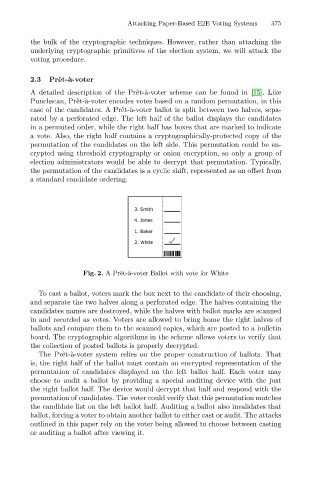
                          A detailed description of the Prˆet-`a-voter scheme can be found in [15]. Like
                          Punchscan, Prˆet-`a-voter encodes votes based on a random permutation, in this
                                                     a
                          case of the candidates. A Prˆet-`-voter ballot is split between two halves, sepa-
                          rated by a perforated edge. The left half of the ballot displays the candidates
                          in a permuted order, while the right half has boxes that are marked to indicate
                          a vote. Also, the right half contains a cryptographically-protected copy of the
                          permutation of the candidates on the left side. This permutation could be en-
                          crypted using threshold cryptography or onion encryption, so only a group of
                          election administrators would be able to decrypt that permutation. Typically,
                          the permutation of the candidates is a cyclic shift, represented as an offset from
                          a standard candidate ordering.


                                        Fig. 2. APrˆet-`a-voter Ballot with vote for White


                            To cast a ballot, voters mark the box next to the candidate of their choosing,
                          and separate the two halves along a perforated edge. The halves containing the
                          candidates names are destroyed, while the halves with ballot marks are scanned
                          in and recorded as votes. Voters are allowed to bring home the right halves of
                          ballots and compare them to the scanned copies, which are posted to a bulletin
                          board. The cryptographic algorithms in the scheme allows voters to verify that
                          the collection of posted ballots is properly decrypted.
                            The Prˆet-`-voter system relies on the proper construction of ballots. That
                                     a
                          is, the right half of the ballot must contain an encrypted representation of the
                          permutation of candidates displayed on the left ballot half. Each voter may
                          choose to audit a ballot by providing a special auditing device with the just
                          the right ballot half. The device would decrypt that half and respond with the
                          permutation of candidates. The voter could verify that this permutation matches
                          the candidate list on the left ballot half. Auditing a ballot also invalidates that
                          ballot, forcing a voter to obtain another ballot to either cast or audit. The attacks
                          outlined in this paper rely on the voter being allowed to choose between casting
                          or auditing a ballot after viewing it.

