


Page 385 - Towards Trustworthy Elections New Directions in Electronic Voting by Ed Gerck (auth.), David Chaum, Markus Jakobsson, Ronald L. Rivest, Peter Y. A. Ryan, Josh Benaloh, Miroslaw Kutylowski, Ben Adida ( (z-lib.org (1)
P. 385
Attacking Paper-Based E2E Voting Systems
                                                                                            377
                          supported when election officials and auditors can be trusted to honestly follow
                          proper election procedures.
                            The accuracy of vote counts in Punchscan and Prˆet-`a-voter is dependent on
                          the proper construction of ballots. To deal with this both systems rely on pre-
                          election audits of the ballots to ensure the ballots were created correctly. In
                          the Punchscan scheme, election officials commit to the set of ballot forms and
                          audit some percentage of the ballots, looking for irregularities between the actual
                          ballot forms and the commitment on the Punchboard. Tampering with the set
                          of ballots between the audit and the election has a good chance of being caught
                          during the post-election audit. Here we will describe a way to tamper with the
                          ballots in a way that would not be detected with typical audit procedures.
                            In this attack, a small percentage of ballots are replaced with tampered ballots.
                          The front sheet of each of these ballots remains the same as their untampered
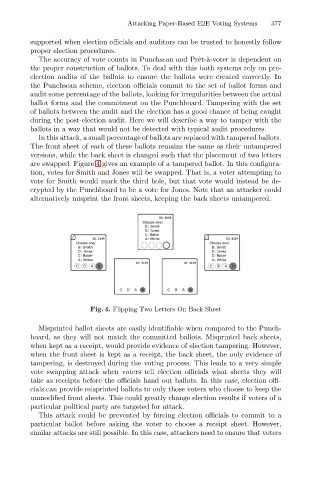
                          versions, while the back sheet is changed such that the placement of two letters
                          are swapped. Figure 4 gives an example of a tampered ballot. In this configura-
                          tion, votes for Smith and Jones will be swapped. That is, a voter attempting to
                          vote for Smith would mark the third hole, but that vote would instead be de-
                          crypted by the Punchboard to be a vote for Jones. Note that an attacker could
                          alternatively misprint the front sheets, keeping the back sheets untampered.


                                          Fig. 4. Flipping Two Letters On Back Sheet

                            Misprinted ballot sheets are easily identifiable when compared to the Punch-
                          board, as they will not match the committed ballots. Misprinted back sheets,
                          when kept as a receipt, would provide evidence of election tampering. However,
                          when the front sheet is kept as a receipt, the back sheet, the only evidence of
                          tampering, is destroyed during the voting process. This leads to a very simple
                          vote swapping attack when voters tell election officials what sheets they will
                          take as receipts before the officials hand out ballots. In this case, election offi-
                          cials can provide misprinted ballots to only those voters who choose to keep the
                          unmodified front sheets. This could greatly change election results if voters of a
                          particular political party are targeted for attack.
                            This attack could be prevented by forcing election officials to commit to a
                          particular ballot before asking the voter to choose a receipt sheet. However,
                          similar attacks are still possible. In this case, attackers need to ensure that voters

